When the NYTimes holds up a mirror.
Great article but not fun to read.
Showing posts with label new orleans crime. Show all posts
Showing posts with label new orleans crime. Show all posts
Thursday, October 08, 2009
Thursday, August 20, 2009
Not News: Gun Battle Outside Mayoral Campaign HQ
Yesterday afternoon, I was nearby enough to hear the machine gun fire that occurred right outside Mayoral candidate James Perry's new campaign headquarters.
He's just opened up shop there, right on the corner of Palmyra and S. Dorgenois and his building narrowly avoided getting sprayed with bullets yesterday evening at around 5:30ish.
Apparently, two cars came screaming down Palmyra St. before one opened fire on the other.
Luckily, nobody got hit or hurt.
Remember that this happened just a stone's throw away from Orleans Parish Prison, Orleans Parish Criminal Court, and thus, tons of police officers.
That demonstrates a depressingly bold disregard for consequences. Or, unfortunately, a fearlessness of consequences.
This is why DA Cannizzaro feels he needs to go all bullworth on his own office and the NOPD. We've got a broken criminal justice system...
-
Strangely, the venerable Times-Picayune doesn't think it's news when a mayoral contender has to hit the deck as some nutcase fires off a round right outside his office.
I don't just know about it because I saw him standing outside as the police arrived, James Perry released a statement about the attack within an hour or so of the gun battle.
There was nary a mention of it in today's paper.
What gives? Was the story about the guy masturbating in a parking lot really so important that it couldn't be bumped from B-2?
Perry's statement is here.
New Orleans, LA – James Perry, New Orleans Mayoral candidate, released the following statement on the gun battle that occurred moments ago just outside his campaign headquarters.
James Perry, New Orleans Mayoral Candidate: “The gun battle outside my campaign headquarters brings home a point many of us know all too well: we will not be able to move forward as a city until we solve our public safety crisis.”
“Our city’s future depends on our ability to confront violence in our communities today. Our public safety crisis puts our families needlessly in danger, keeps our city from moving forward and attracting more and better jobs. Confronting violence will not be easy, but as we proved many times before, we are resilient, we are strong, and together, we are capable of fixing our public safety crisis.”
“I thank God that no one was injured, and I ask him for continued strength in our campaign to bring safety to our city’s streets. But make no mistake, even a hail of gunfire on the sidewalk outside of my campaign headquarters will not discourage me from my mission to become Mayor and make our city safe. In fact, it strengthens my resolve to fight for this city and its future so that we can finally have the New Orleans we all deserve, not the New Orleans we have today.”
At 5:20pm a fierce gun battle occurred in front of the James Perry for Mayor Headquarters located at 2547 Palmyra Street in New Orleans, LA. Perry and his entire campaign were inside the office as approximately 20-30 shots rang out. No one was injured and the New Orleans Police Department is currently on the scene.


Monday, July 13, 2009
Public Safety, Crime, the NOPD, and the 2010 Mayoral Circus
That's the theme for the next weekish here at WCBF.
This is an open thread as I work to prepare some stories and analysis to publish at my convenience.
Is crime a problem by itself or a symptom of other problems?
What should the next Mayor do in an ideal world and to what extent do real world political constraints limit those options?
Links Update:
1. NOPD's misleading rape stats
2. Investigations into racist vigilante killings during Katrina moving forward?
3. NOPD bar fight cover up
Links Update 2:
4. Audit finds $200,000 missing from NOPD evidence room
Sunday, March 29, 2009
Checkered Past Comes Full Circle
Maybe you saw this in the paper on Friday:
The City of New Orleans must release to The Times-Picayune police department records of 10 officers, including Superintendent Warren Riley, related to any misconduct investigations or complaints, a judge ruled this morning.
"They're entitled to these records," Civil District Court Judge Robin Giarrusso said after a hearing in her courtroom. "Public records are public records are public records, and the citizens of this city have a right to know what's in them."
Yes, the public needs to know that it can trust the public integrity bureau. Given the NOPD's horrendous relationship with the public at present and by historic reputation, one would think that if the NOPD had nothing to hide, they'd be anxious to open up to the media about how they do business.
But as the article continues, we learn that it's not just the media that's been spurned by NOPD record keepers:
NOPD advocate groups tried to block another person's request for 16 decades' worth of police complaint records, suing the city and arguing in court Friday that the officers are entitled to a "right to privacy" that goes back to the framing of the U.S. Constitution. Their attorneys suggested at the hearing that they would appeal Giarrusso's ruling to the 4th Circuit Court of Appeal.
The newspaper intervened in an effort to allow the city to answer McCarthy's request.
Other parties, including the Orleans Parish Public Defenders, were also asking for the NOPD Public Integrity Bureau records. One woman had asked the city for every Public Integrity Bureau file dating to 1992.
So it doesn't seem to be Riley's reactionary stance to the "Times Pick-on-you," it's actually long standing NOPD policy. What might it be specifically about the public integrity bureau?
Again, the T-P's Gwen Filosa provides some historical context:
In 1954, the New Orleans police department created an "internal affairs" division, Mince said, but in 1995 then-Police Superintendent Richard Pennington abolished it.
"He said, 'We're going to have a public integrity bureau," she said. "He recognized the need to restore public trust in the New Orleans Police Department."
Riley in 2002 was part of a task force charged by Mayor Marc Morial to review law enforcement's performance, Mince added. The task force members agreed that "an educated and informed citizenry" was key to following the freedoms guaranteed by the U.S. Constitution.
But there is A LOT more to it than what was included in yesterday's paper.
You have to remember what precipitated Pennington's move, or really what even brought Pennington into town in the first place. A few months ago, I happened to be digging into a little bit of NOPD history and became very much fixated on what was going on in the early '90's. Certainly these are not good times at the NOPD but what was going on before Pennington joined the force was mind-boggling. We're talking about some Wild West bullsh!t going on - from the rank and file all the way up to the top of the force.
Using Lexis-Nexis, I came across a 60 Minutes transcript from the fall of 1994 that gets at some of what was going on at the time. At that time, Joseph Orticke was police superintendent and the Department of Justice had just named the NOPD worst in the nation for police brutality. Without excerpting large segments of that transcript, Mike Wallace profiled several visionary crime fighters who deserve some description:- Former NOPD officer Michael Thames was imprisoned for skimming from illegal gambling, drug, and prostitution rackets to the tune of $100,000 per year. When asked about the Rodney King beating in L.A., Thames responded that he didn't know what the big deal was because that was "kiddie-land" compared to New Orleans.
- Dr. Frank Minyard, New Orleans coroner (to this day - more on him some other time) defended his office against charges that it fudged an autopsy of Adolph Archie who wounded after killing a cop only to be intercepted by a mob of police officers on the steps of Charity Hospital, taken to a police station, and beaten to death while in custody.
- Antoine Saacks was a 28 year veteran of the force and the NOPD's second-in-command under Orticke before getting fired a week before 60 Minutes got to town. On a salary of $50,000 per year, Saacks boasted millions of dollars in assets related to number of schemes including a vice-squad extortion racket in the French Quarter, exacting 'fees' for permitting officers to moonlight as private security in the film industry, and by setting up an operation to capitalize on video poker by connecting Vegas firms to a mafia-connected Bourbon St. landlord named Frank Caracci.
In 1994, the Clinton Administration granted the Civil Rights division of the Department of Justice new powers to take over troubled local police forces with poor track records on civil liberties, brutality, and racism. Only a handful of police forces were ever taken over but a certain degree of the law's effectiveness is derived from police policy adjustments made under threat of takeover. Given some of the issues illuminated above, certainly the NOPD was an early candidate for receivership takeover. Mayor Morial's decision to search outside the city for a new police chief in '94 resulted partially from this downward pressure out of Washington D.C. Perhaps not-so-coincidentally, the man he picked, Richard Pennington, was plucked from D.C.'s force.
After police pay was frozen for some time in 1982, starting salaries for NOPD officers was still so low when Pennington came in that they had to be doubled. Internal affairs was liquidated and the officers were dispersed. Pennington then created the public integrity bureau, moved it outside of precinct HQ and added FBI agents to its staff.
Chief Pennington's adjustments weren't a cure all by any stretch, as issues with brutality and corruption continued to plague the force to the point that the Department of Justice opened up an official investigation into New Orleans in 1996 to monitor the reform efforts.
The general consensus of the city seems to be that the Pennington era of the NOPD was a success. Significant progressive reforms were instituted that made a pretty noticeable dent in the city's crime stats and in public perception of safety.
-
It is crucial to understand the context behind the decision to scrap internal affairs for the public integrity bureau.
Though those changes may have come regardless, the most direct catalyst was the murder of Kim Groves, which occurred just six hours after Pennington was sworn in.
Groves was murdered as a result of an execution order from NOPD Officer Len Davis, who was tipped off from within internal affairs after Groves filed a report that she had witnessed Davis senselessly beating a teen aged suspect.
At the time Davis ordered Groves' death, he was also one target in a wide-ranging federal drug investigation. Officer Davis was apparently one of at least 15-20 officers helping to guard cocaine warehouses run by undercover federal agents. Groves' killing ultimately short-circuited the drug case, as only ten officers ended up being charged. (At least according to the July 13, 1996 Washington Post article that helped me guide the narrative of this case.)
-
So let's get back to Superintendent Warren Riley's defensive protection of records related to internal affairs and the Public Integrity Bureau. What was Warren Riley doing back in the early '90s?
Well, he was at Internal Affairs, assigned there in 1991 after several years between the maligned Narcotics and Vice squads.

Riley was on duty on February 17th, 1995, when Sharon Robinson came forward to report that she feared for her life because she'd just ended things with her then-boyfriend, NOPD Officer Victor Gant who had a long history of physically abusing her and had repeatedly threatened to kill her in the event that she left him.
Officer Riley did not file a report or open an investigation.
Months later, on April 27th, 1995, after Riley had been transferred to the 6th District, Officer Gant approached Riley to discuss Robinson's coming forward to Riley, for which she had apparently confessed. Gant told Riley that the couple's issues had been resolved.
Sharon Robinson's body was found drowned in a swamp days later.
Here's a 1995 article from UK Independent that profiled Officer Victor Gant after he was named a suspect:
The target of the hunt is a serial killer who, investigators believe, has struck at least 24 times. The FBI think that Gant may be the killer but they don't have enough evidence for an arrest. So Gant sits at his desk, suspended from patrol duty. If you have his telephone number, you can call him and hear his Louisiana drawl: "I can't really discuss the case, you'll have to talk with my lawyer."
Gant became a suspect after Karen Ivester was found strangled. Her body was dumped in the swamp about half a mile from Interstate 55, just 30 minutes from the French Quarter of New Orleans. As local police combed the scene they found a second corpse, another young woman. Sharon Robinson had been drowned. She was still dressed in her work clothes, a uniform from the Harrah's Casino in New Orleans. Before death, her head had been shaved. In life, Robinson and Ivester had been best friends.
Police inquiries at the casino revealed that Robinson had left work on 29 April this year at 3am accompanied by Gant, a 33-year-old officer who was once her boyfriend. The New Orleans Police Department immediately named Gant as a suspect. Then the FBI announced that the man who killed Robinson and Ivester had also claimed 22 other victims.
Twenty-one of the killer's victims had ties to prostitution, Ivester included. Nineteen were known prostitutes, including one man. There were two other male victims and there is evidence to suggest they were also prostitutes. According to NOPD sources, each body carried some distinctive marks that matched through all 24 deaths.
--
Gant used to patrol in Treme and Algiers. Several residents say a group of New Orleans police officers has operated a string of prostitutes in the area for years. Some say they've seen brutal beatings and threats of murder and a few have claimed Gant was an associate of one suspect group which allegedly ruled through intimidation.
On a recent Friday night the bars along Treme's Claibourne Avenue were busy and outside each one there was a small clutch of women working the street. Many are scared, some are aggressive and few were willing to speak. When they do, they insist on anonymity.
"The police and the politicians don't really care about us," said one. "It took over a dozen deaths before those motherfuckers lifted a finger to find the killer. I knew two of the three girls who died but I wouldn't tell the police about it. I'd be the next one dead if I did." The woman then went further. "I saw the girl called Peach just a couple of days before she was murdered. The thing is, some of the cops were running the girls around here, they were pimping. Some people say Peach got out of line."
"Peach" was the name used by Karen Ivester. According to FBI investigators, Gant had told some acquaintances that he disliked Karen Ivester because she had persuaded her friend not to join her in prostitution. Local papers report that the Treme prostitutes have been victims of an intimidation campaign by a group of rogue police officers.
Upon the discovery of Robinson's body, Officer Riley wrote a letter to Major Loicano at the Public Integrity Bureau, telling him of Robinson's visit the previous February.

It was Major Loicano who ultimately reported Riley's violation, as we can see from the Major's testimony at Riley's appeal of the suspension to the Civil Service Commission in 1998:

---
Now to bring it all back, lets get back to Filosa's article:
At issue was a request by newspaper reporter Brendan McCarthy to view any Public Integrity Bureau records kept by the New Orleans Police Department on Riley, along with his top three officers and the officers involved in the Jan. 1 fatal shooting of 22-year-old Adolph Grimes.
Certainly, we can understand how it is in the interests of Superintendent Riley and PANO (Police Association of New Orleans) to deny public records requests related to Internal Affairs and the Public Integrity Bureau. And we can also understand how it's in Superintendent Riley's interests to deny the public the right to inspect his own complaint records.
But I think it will be very interesting to examine common threads possibly bind all ten officers in McCarthy's request together. How many of Riley's top Lieutenants came from the old internal affairs outfit of the early '90s? What about from narcotics and vice of the '80s?
The most disturbing thing to think about is how the NOPD in total seems to have gone full circle back to the old pre-Pennington days. How many brutality cases have we heard about since Katrina? How many arrests of uniformed officers? And how much never sees the light of day?
Saturday, March 28, 2009
Tuesday, March 03, 2009
Camera Ca-Ca
The executive summary of the OIG's report on the city's horrendous crime camera contracting process via WWLTV (the whole report is available via the Gamblog):
The City of New Orleans Office of Inspector General (OIG) conducted a review of a project to deploy a city-wide system of neighborhood surveillance cameras to help the police in their battle against crime. The project originated in 2003 when Mayor C. Ray Nagin announced a plan to install up to 1,000 video surveillance cameras as part of a crime fighting initiative. The OIG review determined that the Mayor's Office of Technology (MOT), which was charged with implementing the project, did not conduct an orderly planning process, comply with prudent procurement practices, or exercise effective contract oversight at any stage of the project. The City's surveillance camera project was undertaken without a realistic budget or a funding plan. After conducting a flawed request for proposals process, the MOT awarded a contract for the deployment of 240 cameras to Southern Electronic Supply, Inc. (Southern) in 2004. With the project less than 25 percent complete after two years, the MOT abandoned Southern‟s contract. Over the following two years, the MOT went through a series of three more contractors before the project was completed on July 31, 2008 with 214 cameras deployed. The MOT‟s internal cost estimate for the 240 camera project was approximately $2.6 million. After vendors submitted initial project proposals, it became apparent that the MOT had seriously underestimated the likely cost. The MOT also failed to control expenditures and allowed costs to mount to more than $6.6 million, exceeding the amount appropriated for the project by a wide margin. Despite its cost, the completed project is not designed or built to operate reliably and will be expensive to maintain. None of the four contractors on this project was held accountable for the quality of work or the performance of the camera system. When the final contractor deemed the project complete on July 31, 2008, it reported that 205 of the 214 cameras were operational, but an OIG inspection determined that only 114 of the cameras were working on September 18, 2008. The City blamed Hurricane Gustav, which struck on September 1, 2008, for most of the camera failures observed by the OIG. The high rate of failure may be partly attributable to the architecture of the communications network, in which the movement of a single antenna can disrupt the operation of an entire series of cameras. The OIG found that many installations were highly vulnerable to wind events, as camera equipment and plate antennas were often installed in a makeshift manner that would not meet the standards for a traditional public works project such as traffic signals or signage. The findings in this report describe problems that contributed to the project‟s failure to meet the City‟s expectations. Major findings include the following:
The organizational structure of the MOT, which relied on subcontractors to manage its operations, undermined accountability.
The MOT lacked the expertise to successfully plan the surveillance camera project and relied on assistance from one vendor to the detriment of fair competition.
Installation of Crime Surveillance Cameras 2003-2008 Office of the Inspector General, City of New Orleans 10 of 50.
The MOT's request for proposals process did not ensure that the City received the benefit of competitive prices for equipment and materials for the project.
The contract with Southern did not hold the contractor accountable for system performance or provide a meaningful warranty for the work.
The MOT failed to control expenditures and made $286,423.85 in overpayments to Southern, based on records provided to the OIG.
The MOT tacitly approved an improper lease agreement that allowed a subcontractor to profit from self-dealing.
The City made payments totaling $770,624.52 to Dell, Inc., without documentation to show what was purchased.
The MOT failed to either maintain project records to document work performed or inspections done of contractors‟ work.
In 2008, the MOT entered into a no-bid, open-ended agreement with Ciber Inc. to enhance the City's communications network without determining the likely cost.
The MOT's agreement with Ciber provided no warranty or performance standards and the network Ciber built does not meet the MOT‟s expectations for reliability.
The MOT incurred charges for the surveillance camera project that exceeded its budget for 2008 by $2.5 million.
The management problems detailed in this report pre-date the tenure of the City‟s current Interim CTO, who began work in August 2008. In his first few months, the current Interim CTO has taken steps to address some of the problems identified in this report, but more changes are needed to guard against performance failures and cost overruns in future projects. The report concludes with the following recommendations for change:
1. The City should reduce its excessive reliance on contractors for information technology services.
2. The City should procure all services using a competitive process based on a clearly defined scope of work and a maximum contract cost.
3. The City should adopt contract terms and contract oversight procedures that hold contractors accountable for the quality of their work.
4. The City should correct weaknesses in its fiscal oversight procedures that threaten the integrity of its budget.
5. The City should develop a plan and budget before undertaking any future project.
What does it mean that our city's government just had to be told that it "should develop a plan and a budget" before it proceeds with initiatives?
It means our city government is pathetic. But everyone that lives here knows that. How sad.
It's very nice of the OIG to release this report as the Mayor moves to hand out a professional service contract for the maintenance of our crime camera portfolio. As you'll recall, two weeks ago, Mayor Nagin abolished the advisory board that would have acted as third party to the award of that contract after City Council attempted to make the entire proceeding open to the public.
Executive orders have consequences.
I urge City Council to work together to unanimously and unequivocally end the crime camera program forever.
The cameras have been largely inoperable. They have not aided in the prosecution of any criminals. They have cost us millions of dollars over several years.
All of that money should go toward repairing street lights around the city. Properly functioning street lights can deter crime and allow people to feel more secure in their own neighborhoods.
How do we work this out in a unified way?
--
Meanwhile, interim Inspector General Len Odom and US Attorney Jim Letten will have to decide whether or not to pursue prosecutions related to the crime camera investigation. I urge them to proceed. White collar crime is the most harmful kind of crime. Individuals that have broken the law should be held accountable.
Monday, February 16, 2009
Nossiter!
The Gamblog has just pointed out that the New York Times has been especially attentive to New Orleans over the past few days. Kevin Allman links this article by Adam Nossiter about day laborers as victims of crime.
I'm glad he did because the article sucks. I see it as an example of Mr. Nossiter's often incendiary and anecdotal perspective on race in New Orleans.
But on the street, these laborers are known as “walking A.T.M.’s.”
Their pockets stuffed with bills, the laborers are vulnerable because of language problems and their status as illegal immigrants. And as Hispanics have become the prey of choice in crumbling neighborhoods here in one of America’s most crime-ridden cities, racial friction between the newcomers and longtime black residents has moved close to the surface.
-
Many bluntly assigned a racial component, saying that it was “los morenos” — their colloquial term for blacks — who were after them. “When we are leaving here after work, we have to go on foot,” Mr. Billado said, speaking through an interpreter. “The blacks are waiting for us. They’ll beat you up. They’ll take your money.”
I don't want to dismiss the tragedy that is the victimization of hardworking New Orleans residents and the plight of undocumented workers in general. Nor do I want to dismiss the notion that there is tension between Latino and African American communities.
But Nossiter seems to cherry-pick quotes and structures his narrative to suit the needs of a predetermined meme - that racial tension has resulted in African Americans preying upon Hispanics.
The anecdotal quotes from victims of crime are given the lede but the causal factors - the high rate of crime generally, African American joblessness and underemployment, the overall vulnerability of undocumented workers, and the fact that African Americans are so often victims of crime themselves - are buried on page 2 or left out entirely.
Furthermore, this article could have been written at any point over the last three years and the issue of the vulnerability of immigrant laborers to robbery in New Orleans has been covered by local and national media.
Nossiter does not break a new item anywhere in the article so I question the choice of subject.
If he wanted to take the pulse of the city, he might want to examine the backlash bubbling up against the NOPD that has been separately emanating from black, white, and brown quarters.
He includes a line about this:
The police, the men said, either ignore their calls, admonish them for being in the country illegally or arrive too late at a crime scene to do any good.
But what could have been useful in another context becomes a throwaway within this article in particular.
-
Did anybody else get a little queasy reading this Nossiter piece? Or am I being a cherry-picker too?
Wednesday, February 11, 2009
A trail of busted doors
Note from Eli: Everyone be nice to the letter "a."
So last night I attended a candidate forum at the Uptown Jewish Community Center. Eastern New Orleans state representative Austin Badon Jr. was the featured candidate. The talk motivated me to contribute my first-ever post to this here blog, a longtime favorite of mine. I cross-posted this at http://www.theneworleansinstitute.com, the New Orleans Institute website where Karen Gadbois and I are regular contributors. FYI: My background is in traditional print reporting so forgive the non-blog-style blog post; I like stories with ledes and quotes sometimes too. Here goes:
We are officially living in a war zone.
Eastern New Orleans mayoral hopeful Rep. Austin Badon raised eyebrows last night with a call for a new Stazi-style approach to crime fighting, telling a roomful of District B voters that if he is elected mayor they will see “the NOPD kicking in at least four doors a day.”
The line appeared to stun many in the audience of uptown neighborhood leaders who had come to hear Badon, many of them for the first time. Upon reading furrowed brows, Badon quickly added that he would not lose track of “civil liberties and all that” and pointed out in a style reminiscent of police chief Warren Riley that most of the violence in the city was between “thugs and drug dealers killing each other off.”
The similarity to Riley was ironic as Badon emphasized throughout the talk the need to take him and other members of the current administration out to pasture.
“We are going to bring the best and brightest people,” he said. “Right now I am working to set up meetings in Miami to look at the best people, the best police chief to bring here.”
Badon appeared to have given more thought to crime than other issues, such as planning. While he did not know that the city’s master plan has not yet been written, he was prepared enough to note that the police chief he picks will be, unlike Riley, on the same page as the district attorney and the business community.
“The next police chief will be someone who has the support of the business community and the DA,” he said.
Badon, who considers himself a fiscal conservative, also noted that the City Council and the mayor “need help.”
“They are somewhere between Days of Our Lives and The Young and the Restless and I am not happy with what I see,” he said in response to a question about the behavior of the city council.
The married and childless Badon had no love either for Director of Public Works Robert Mendoza. He named public works as the department most in need of restructuring, as well as more funding. “I have been with the manager (of public works) and heard things I don’t agree with. They should not be treating you taxpayers the way they are.”
The nebulous statement was followed up with an explanation of why he hadn’t read any of the reports put out by the city or the Bureau of Governmental Research that describe possible restructuring. The reason?
“When there is a study, they don’t send it to us,” he said.
But if the 2010 mayoral race ends up turning on issues of personal style, New Orleanians better get used to sending their studies Badon’s way.
The little-known state representative showed up last night to the informal forum dressed to the nines with a sharply-tailored zoot suit jacket ( hello inverted back pleat!) and a four-pointed hankie in his breast pocket. The unstoppable outfit set the right tone for a campaign presentation long on big, sometimes extreme statements, and short on nuance.
Police accused in killing accused of lots of other stuff
T-P:
The record of Sgt. Daniel Scanlan, a ranking member of the nine-person unit involved in the shooting, has become a flash point in the wake of the killing. Some community leaders have questioned police tactics -- particularly the aggressive, plainclothes units like the one Scanlan helped lead -- and have called for a thorough vetting of each officer involved.
Police records show that only one of the dozens of complaints lodged against Scanlan has been sustained by New Orleans Police Department internal investigators, and that ruling was overturned on appeal by the Civil Service Commission.
--
But here's the real kicker, from PANO:
Capt. Michael Glasser, president of the Police Association of New Orleans, said the officers involved in the shooting have solid records. He drew a comparison between the Grimes case and another recent high-profile shooting, that of French Quarter resident Wendy Byrne, who was killed in a confrontation with three robbers. Quarter residents, Glasser said, want a strong police presence, with officers stopping, frisking and questioning people.
"You have thugs running around with guns robbing people, " he said. "Yet, just a few blocks away, cops are criticized for stopping a guy with . . . guns in his car and no real reason to have them."
ARE YOU FREAKING KIDDING ME? "COPS ARE CRITICIZED FOR STOPPING A GUY?"
Officer Glasser, please get real. I think people's criticism derives from the strong possibility that these cops may have MURDERED a guy. Slight difference, no?
That guy was named Adolph Grimes III. He had no criminal record, was engaged to be married, and had a permit to carry a weapon. He was in town to visit family for the New Year.
Police shot him nine times in the back, half a block from his grandmother's house.
Hours earlier those same officers terrorized the Crutchfield family with guns and tasers.
Officer Glasser has every right to do his job and defend his fellow officers, but he can do so without denigrating the victim or insulting his grieving family. Show some class.
Thursday, January 29, 2009
Bad Politics By French Quarter Chotchky Elite
Unless you've been living under a soundproof rock, you know that this city's been gripped by a particularly nasty wave of violent crime since the New Year and citizens across New Orleans are fed up.
Of course people are fed up with the actions of violent criminals but what makes the reaction to this crime wave different is the overwhelming frustration with the NOPD itself.
This frustration is felt in black neighborhoods, white neighborhoods, uptown neighborhoods, and downtown neighborhoods. People do not trust the police. People do not respect the police. Too many officers have been arrested for crimes themselves. There are too many documented and anecdotal stories of indifference and laziness, brutality and violence on the part of the NOPD. Too many caught criminals have been released because NOPD officers don't file police reports properly or on time. Statistically speaking, if you murder somebody tomorrow in Orleans Parish, there's only a 20-30% chance you'll ever fact legitimate punitive jail time. And so on and so forth...
Again:
[E]xperts have already identified many of the major issues facing the NOPD. The NOPD itself ordered an audit by BGI in 2007. But after BGI identified several systemic failures and prescribed a blueprint toward the superior community policing model, the NOPD suppressed the report for months. To this day, Warren Riley has failed to substantively institute the suggested reforms.
Wendy Byrne's murder in the French Quarter was certainly a flash point. But so were the murders of little Ja'Shawn Powell and Adolph Grimes. It's the compounded frustration of so many instances of violence touching so many of our lives that I think compelled so many people to participate in some of the organic anti-crime activities of the last week.
But piggybacking on some of those efforts was today's so-called "Meeting of the Minds." They called a big press conference in the Royal Omni Hotel to call attention to a petition they circulated that calls for a number of both totally reasonable and extraordinary measures to address crime in the French Quarter and Marigny Triangle. Here is the list of signatories:
• Chuck Ransdell, chair, Meeting of the Minds
• Eric Reitman, president, French Quarter Business Association
• CoCo Paddison, president, French Quarter Citizens
• Jude Marullo, president, Bourbon Street Merchants Association
• Chris Costello, president, Faubourg Marigny Improvement Association
• Lori Herbert, vice-chair, North Rampart Main Street
• Samara Poché, president, Lower Quarter Crime Watch
• Ken Ferdinand, executive director, French Market Corporation
• Darryl Berger, senior chair, French Quarter-Marigny Historic Area Management District
• Mike Moffit, president, Vieux Carré Property Owners, Residents & Associates
• Christine Sory, president, French Quarter Business Women’s Network
• Beth Lovett, representative, Upper Quarter Neighborhood Watch
• Stephen Swain, president, Patio Planters
• Jason Patterson, chair, Frenchmen Street Coalition
Anybody missing from that petition?
Yes. The entire rest of the city.
By discussing the crime problem as something specific to the French Quarter and the Marigny, these organizations are demonstrating a callousness to the much more frequent violence occurring in every other neighborhood.
It allowed Superintendent Riley to couch his response in these terms (video available):
"We understand the value of the Quarter to the city, but we also understand the value of every community."
--
"This is one New Orleans,” he said. “We are not gonna pull other resources from other parts of the city, to put into the Quarter, when we feel we have a sufficient force there at this point."
That argument is going to win every time.
---
In a similar vein, the Mayor has challenged the same business community by backing off a prior compromise agreement with City Council to fund full sanitation services. Council is livid because the Mayor seemingly sprung this upon them without any kind of warning. They're threatening legal action to compel the Mayor to continue FQ sanitation services. After it seemed like a compromise was already in place, why would the Mayor all of sudden threaten to pull the rug out from under the French Quarter by cutting sanitation right before the busiest season of the year?
It's a proxy war, I tells ya.
It's another opportunity to force French Quarter business owners to demand extra services, money, and attention denied to the rest of the city's residents.
It forces the FQ business community to engage in two geographically-specific battles against the administration at once.
Good divide-and-conquer strategy by the Nagin administration.
Predictably bad strategy of exclusion by various French Quarter business associations.
Sunday, January 25, 2009
Mostly Crimey with Crime Expected Later

That was the weekend forecast and it was unfortunately accurate.
It is ubiquitous. It is in every neighborhood in this city, it affects every group of people in this city.
On Friday night, I was sitting on the stoop of a friend's house in the LGD and heard that morning's double shooting on the 700 block of Ninth.
On Saturday, I went to Wendy Byrne's memorial second line parade.
Today, Sunday, I learned that my old landlady was nearly beaten to death by her own son.
The Times-Picayune was chock full of long pieces detailing the many ways crime hurts our communities.
From Laura Maggi, Brian Thevenot, and Brendan McCarthy, on getting away with it:
District Attorney Leon Cannizzaro said the daylight killings speak to a pervasive lack of respect for the justice system."They are not concerned about the consequences," he said. "They are not concerned about who might be watching."
That attitude stems from a grim reality: Most killers here do get away with it.
So far, the New Orleans Police Department has made arrests in 59 of the murder cases in 2008, or 33 percent of the total. Prosecutors have accepted 32 of those cases, refused 11 for insufficient evidence and are considering whether to pursue the remainder. None of the cases has yet been tried.
Even if convictions are secured in every case accepted so far -- highly unlikely -- that would mean the city would punish just one in five killers. Police could secure more evidence and make more arrests at any time, but homicide cases generally do not age well, becoming tougher to solve with every day that goes by.
From Keith Spera, on front doorstep gunfire:
Until now, my wife and I have chosen to remain in the neighborhood and accept whatever risk that entails. But what of our responsibility to our child?
Does it make sense to raise her in a neighborhood, or a city, where killing is routine?
From Brian Thevenot, an artist asks the most important question:
"To me, I'm making American art; to a lot of folks, I'm making black art," he said. "It's the same with the murder problem -- people see it as a black issue. ... How can we get people to see that we live in one world?"
I leave that question for last because I think it helps give us a framework for evaluating WWL's Sunday panel on crime, featuring Samara Poche of the Lower Quarter Crime Watch, Mike Moffit of the Vieux Carre Property Owners, Residents & Associates, and Thom Khaler of NO Crimeline.
They got some things right and some things so very very wrong.
Perhaps the most glaring issue wasn't the fault of the panel at all, it was the panel itself. Limiting a discussion about crime in New Orleans to the French Quarter perpetuates the same kind of provincialism that has always stopped us from getting at the big picture. That the French Quarter has experienced a rash of high profile violent crimes recently shouldn't be put to the side, but it is a constant source of frustration throughout the city that panels aren't organized on WWL when young men are slain in the 7th ward. That crime seems to get be on the radar only when tourist-oriented businesses are threatened is insulting. And to hear the crime issue couched in these terms during the panel was bothersome.
The panelists were on the money about some really important things. The issues with the NOPD start at the top with Police Superintendent Warren Riley. So long as he continues to poorly manage his force, there will be no change. The panelists seemed to understand that the issue is not money or manpower. New Orleans has more cops per capita than most cities in the US and it's almost impossible for us to devote a greater percentage of our city budget to police equipment than we already do. They also pointed out that the typical Warren Riley PR move in during a crime wave, sending out officers on more vehicle patrols, will not do. Foot patrols force officers to interact with residents, to learn names and faces, and helps foster trust while increasing the sense of safety.
But by and large, things got sticky when the panelists were asked to prescribe medicine. Panelists seemed to think that one of the problems was that the NOPD was not making the quality of life arrests it needs to make, that it was not enforcing petty crimes and this was leading to big crimes. One panelist seemed to think that the NOPD had gotten away from the strategy of racially profiling potential criminals, following young men who wear hoodies and then frisking them if they spit or jaywalk or the moment they have a millimeter of probable cause.
This is most definitely the wrong approach. In fact, the major problem with the NOPD right now is that they're using up all of their resources making catch-and-release arrests for drug possession and traffic-related bench warrants. If anything, the NOPD is arresting too many people. New Orleans and Jefferson Parish arrest more people than anywhere else in the country. We prosecute more nonviolent crimes than anywhere else in the country. This wastes resources and is the biggest reason why we don't focus money on punishing violent crime or on preventing crime in the first place. And certainly encouraging more racial profiling, aside from being an offensive suggestion, is only going to exacerbate some of the other fundamental issues hurting the NOPD: public mistrust and police violence.
In fact, experts have already identified many of the major issues facing the NOPD. The NOPD itself ordered an audit by BGI in 2007. But after BGI identified several systemic failures and prescribed a blueprint toward the superior community policing model, the NOPD suppressed the report for months. To this day, Warren Riley has failed to substantively institute the suggested reforms.
At the end of the segment, Thom Kahler suggests that business leaders may be working behind the scenes to remove Riley, like they did for former DA Eddie Jordan. I'm not comfortable with this if we're not ready to be honest, a. that we can't have a shadow government of business associates determining when and if our ineffective leaders stand down and how much to pay them to do so, and b. that removing the police chief will not reduce our crime rate unless we're also able to get real about the actual problems our police department has.
Friday, January 23, 2009
NOPD Hiding Fund
I missed this from earlier in the week.
Criminal Sheriff Marlin Gusman helps administer a state fund, the Louisiana Crime Victims Reparations Board, which helps families pay for funeral and hospital expenses. But the fund hasn't been making very many payouts, which is surprising considering that New Orleans has the highest murder rate in the industrialized world.
Gusman's office submitted 203 applications to the state board last year and 150 in 2007, resulting in a total of $330,000 delivered to victims of crime in Orleans Parish. The parish's convicts have kicked in $86,000 to the fund during the same time period, Gusman said during a City Hall meeting of the council's Criminal Justice Committee.
"That (payout) figure should be so much higher and it's not," said Capt. Mechelle Delahoussaye, who orchestrates the crime victims' reparations fund for the sheriff's office. "It looks great on paper, but that's in the year and a half in Orleans Parish. We're not running out of money."
Victims' rights advocates, including David Kent of Victims and Citizens Against Crime Inc. said NOPD officers aren't routinely handing out information about the assistance program.
-
Victims don't always get an item number from responding police officers, let alone the brochure about the compensation fund, said civil rights attorney Mary Howell.
"This (informing victims) needed to be done yesterday," Howell said. "I'm sick of talking to people who don't know about it. This is not complicated. If you get into a car accident, you get an item number. But you don't get that slip of paper when your child is murdered."
NOPD Detective Latina Thomas interjected, "Every victim in any crime receives an item number. That's part of our procedure."
"It's not happening," Howell responded, adding that police are by law supposed to notify victims of the fund.
So in other words, the fund isn't being tapped because the police aren't informing the families of victims about their eligibility.
Why don't we look at how this ridiculousness hurts our community with a real life example?
Everyone remembers the tragic murder of Ja'Shawn Powell, an innocent 2-year-old child killed by his absent father around the New Year. This community remains devastated by the event but rallied in support of the victim's family, establishing a memorial fund on their behalf.
It was supported far and wide. There was a vigil, there was a second line.
The memorial fund was established to help defray funeral costs for the family, which is precisely the function of the Louisiana Crime Victims Reparations Board's budget.
The money that should have gone to help pay for little Ja'Shawn's funeral continues to languish in a bank account while the citizens had to scramble for loose change from their couch cushions to help - all because the NOPD can't get it together to hand out brochures to the families of victims.
It is NOPD policy to inform families about the fund but apparently NOPD officers aren't doing that. So is it actually NOPD policy?
Why would Warren Riley not want to take advantage of a the Sheriff's program? It's not like there's any extra paperwork on the NOPD's end. Could it be residual resentment from Gusman's electoral victory over Riley in 2004?
Tuesday, January 13, 2009
One Lesser New Orleans
All of this in one small city in one bad week.
Cayne Miceli
Adolph Grimes III
Ja'Shawn Powell
Monday, January 12, 2009
Friday, January 09, 2009
Silence is Violence: City Hall Edition
I attended today's noon o'clock event in front of City Hall. Turnout was modest in terms of sheer numbers but I was heartened to see so many great neighborhood leaders, activists, and writers. It was a who's-who of people who walk the walk.
At this event, the names of all 183 victims murdered since last year were read aloud. It was gut-wrenching. It's one thing to read all these names online, it's another to hear them because of the time it takes to get through them all. It's a tale of tears.
David Winkler-Schmit brings us the story of Belinda Henderson, the mother of a victim. She's still waiting to see her son's murderer to be identified, captured, and convicted. She also wondering where our elected leaders have been,
“The mayor and the chief of police aren’t out here. Where are they?”
In fact, there was not a single representative from the NOPD present. Not even to make platitudes about the ongoing progress. More specifically, there were only three elected officials present, Councilors James Carter, Arnie Fielkow, and newly elected District Attorney Leon Cannizzaro.
 Hats off to them.
But that they were the only three to grace us with their presence is absolutely shameful.
Council President Jackie Clarkson wears that same red blazer almost every day, and the one time it would have been particularly appropriate, she's a no-show.


It must have been at the cleaners.
Update:
An anonymous friend remarks:
No ribbons
No scissors
No Jackie
Ha ha! But there were cameras.
The Surge Is Working?
The frequency of violent American death in Iraq is down to a rate comparable with the frequency violent American death in the city of New Orleans.
Perhaps a two pronged strategy of adding personnel and incentivizing participation in the Democratic process will help reduce the casualty rate in New Orleans to more manageable levels, you know like Camden, East St. Louis, or Detroit.
Ugh...
Wear red today.
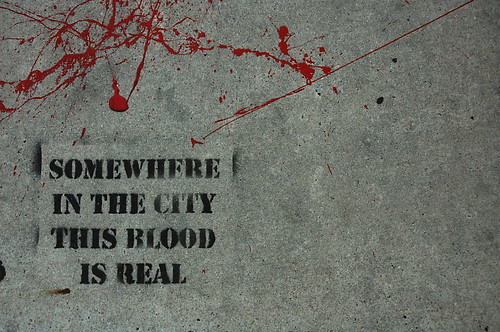
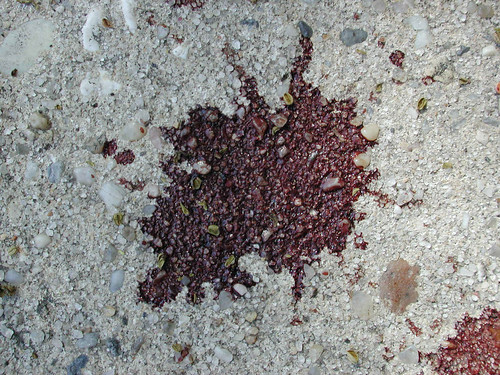
Yes. Tragically, it's very real.
Thursday, January 08, 2009
Wear Red, Skip Work, Make Trouble
Big day tomorrow.
Official Warren Riley Memorial List of Grievances to come sometime later today...
Update - I even wore red pajamas last night.
Tuesday, January 06, 2009
Co-Creators Not Subjects
Brian Denzer writes a strongly worded letter. Must-read.
CC'd to Nagin, Riley, and all of Council.
Tuesday, December 16, 2008
General Strike Called For Jan. 9th
Silence Is Violence looks to make a big statement.
As we approach the second anniversary of the SilenceIsViolence march to City Hall, it has become clear that we once again need to take action. Last year, we stood in front of City Hall and read the names of every citizen who had been killed over the previous year. We did it without a permit, because the city officials responsible for granting permits refused to return our calls. Some of you were there with us; most inhabitants of City Hall were not.
What could possibly get their attention? With their sights so tightly focused on commerce, perhaps the only thing that would get their attention is if we all stayed home and demonstrated what the city would be like without us. When neighborhoods and communities are paralyzed by crime, when tourists stay away out of fear, when young entrepreneurs move elsewhere to open their new businesses, tax dollars are lost and economic energy is stifled. A one-day citywide strike would send a very concrete message of how important our daily safety is to the city's functioning. But, realistically, few of us can afford to call in sick for a day, so we've come up with another variation.
We ask that everyone join us on Friday, January 9th in a citywide "Strike Against Crime." While this strike does NOT require that people stay home from work, we do hope that each of you will find some way in which you can participate, and spread the news to your colleagues and friends.
WWL covered it here.
It is important to me that this be more than an expression of frustration over the crime rate because crime is symptomatic of a social justice deficiency.
Calling out City Hall for its constant adoration of "commerce" at the expense of all else is a hint.
There's a lot of work to do before January 9th.
Subscribe to:
Posts (Atom)

 Posts
Posts

