Showing posts with label RSD. Show all posts

Wednesday, March 18, 2009

Reconsidering Public Education in New Orleans

It's been many many months since I've talked about the state of public schools, which had previously been one of my more consistent beats.

I was pretty demoralized by the way the School Facilities Master Plan went down and the results of the Orleans Parish School Board elections only compounded my misery.

I've been trying to rethink how to approach the issue of public education given that some of the things I had been trying to fight against or force compromise on have become established reality.

One of the things I'd been emphasizing was the disorganized and reckless charterization and privatization. I was worried that the RSD had no real game plan for the eventual restoration of local control over schools. The implications of having such a balkanized administrative model over the short term were alarming; the potential for waste is important enough, but inattentiveness to general admission traditional public schools was scariest.

Although this is anecdotal based off of different things I've heard and read, I have noticed that, lately, there does appear to be increased concern in regard to poor performance at RSD schools. But one thing I think is disingenuous about the RSD is that poor performing traditional schools are almost set up to fail. Poor test scores provide the impetus to bring in charter operators to take over. This is happening at Frederick Douglass High School, for instance. Though the building was in sound condition, it had been slated for closure as recently as this fall; the award winning writing program, Students at the Center, was made unwelcome. In this kind of environment, how can a successful program be implemented? It can't.

But low and behold, Frederick Douglass High School has been saved because a charter operator, KIPP, is now interested in the facility.

Now you may find this kind of approach - helping schools into academic bankruptcy via systemic confusion or neglect - to be pretty disingenuous. And so do I.

Still, Paul Vallas has pretty successfully implemented what he set out to implement - the largest experiment in charterization in the nation's history. Whether that translates into higher achievement for students is another matter entirely. So is whether or not this model is economically or physically sustainable in the medium or long term, given that Mr. Vallas has made me look smart for predicting that he'd stretch his own budget to the max by spending one time revenue on recurring costs.

I advocated for a model resembling something closer to pilot schools in Boston, which allow for the academic exploration and experimentation that was the impetus for progressive embrace of the charter concept in the first place but without the same risks associated with unadulterated private charter boards. The pilot model allows for successes in one school to be replicated in others. Charters organizations, on the other hand, become like mini corporations, and successes are too easily treated as trade secrets. It's the difference between a true public education system and a for-profit education industry.

On the national level, people that have been alarmed by the ramrod approach of some charter proponents do not necessarily have an ally in the Obama administration, depending on whether early stances on issues like merit pay for teachers (which sounds better in theory than it might be in practice) foreshadow other policies.

Given the 'success' of Vallas' charterization plan and the larger momentum of the privatization movement on the national level, local advocates of true public education need to think through where they're at on certain issues and reorient in order to make the best of the new calculus.

One thing I'd like to see is a real shake up at UTNO. I don't know if that means management changes there, since I'm not particularly familiar with who's in charge. But it does mean that there needs to be a focus on organizing the younger TeachNola and TFA teachers. Things like merit pay appear to be on their way. UTNO would be wise to be ready to make sure that the measures used to determine achievement are fair to teachers. Beyond that, there needs to be a plan that grants good teachers legitimate stable job security without entrenching bad teachers. Given that UTNO's relevance has cratered, now is as good a time as any to reorient, as painful as it might be to do so.

On the issue of charters, I think at this point it's hard to just dig in and fight against the charters. It's not that it's an unstoppable freight train, it's that the train has already passed our station. What I think we need to do moving forward is force the RSD, OPSB, and the various charter operators to come up with a road map to local administration where charters cede some degree of control to a centralized body responsible for forceful oversight. In other words, whereas I'd been advocating that we move from traditional public schools directly to something resembling pilot schools, perhaps it's useful to think of the current balkanized charter landscape as the middle step in between the overly centralized OPSB of the past and a pragmatic pilot model that restores the voters of Orleans Parish to their rightful role as overseers of their own schools.

To that end, I found some of what was in this article to be extremely heartening given my low opinion of the new OPSB and the sober reconsideration I've been giving to some of these issues.

Later this week, several groups, including the Committee for a Better New Orleans/Metropolitan Area Committee, the Children's Defense Fund and the Urban League, are expected to announce a new coalition that will explore the future of public education in the city, including the question of long-term governance.

"Everything related to public education will be put on the table, " said Keith Twitchell, president of CBNO/MAC. He declined to release more details until the formal announcement, which is expected Thursday.

--

School Board President Woody Koppel said the board does not intend to "sit idly by" and wait for someone else to determine its fate.

"I believe we need an opportunity, as a community, to openly govern our schools, " he said. "I think that people want to have schools that are run by people who live near them."


It's going to be messy, but hopefully hitting rock bottom this past fall will force us to figure out where the path upward is.

--

I've also been sitting on some really dynamite stuff in regard to how the federal stimulus package touches New Orleans schools but it's all still raw information. I've been really busy but hopefully by next week I'll have something to publish for everyone about that.

Wednesday, February 25, 2009

Jindal distorts own record in order to offer nothing to nation

After spending the day celebrating Mardi Gras, I took a peek at Obama's address to Congress and Louisiana Governor Bobby Jindal's response for the GOP.

Obama's speech was incredible, especially toward the end. Weaving the 'quitters' thing in from the story about the girl from South Carolina? Just beautiful.


Jindal's speech?

Ouch. He's getting put through the paces in the media for his creepy body language and pipsqueak delivery - and rightly so. He was horrendous. Absolutely awful.

To a certain extent you have to put it in context. I mean, what's the GOP response supposed to be after a 52 minute operatic masterpiece by a popular, pro-active commander-in-chief? No Republican in the nation would have been capable of saying anything remotely inspiring in that situation. Not one. That is a function several things - the GOP personality vacuum, the deserved unpopularity of the GOP brand for their 95% culpability in fostering our current dire circumstances, and the overall GOP strategic vision of opposing every good idea of the new President while offering no alternatives - but certainly you'd expect that the great last hope of the conservative fundamentalists would be able to offer something to the American people. He didn't because he couldn't - he has nothing to offer. Nor does the rest of his party. And it must begin crystallizing for conservatives of all stripes that they're going to have to radically alter their political priorities and target coalitions if they're ever to be seen as fit for national power ever again.

Here is a video of Governor Jindal's speech:


Conservative pundit David Brooks gets this:


But let's truly evaluate the lack of substance by looking at the transcript of the speech itself. It wasn't just the meek voice with which Jindal delivered them, it was the words themselves - and what they mean in juxtaposition to Obama's ambitious plans to make America a greater nation.

Jindal's speech lasts just over 2000 words. He doesn't discuss a single substantive policy until he's about 800 words in. He spends the beginning part of the speech introducing his own personal story as the son of immigrants from India. He makes some feint acknowledgment of the need for bipartisanship. And he inexplicably highlights a generic disposition against "government" by telling the story of the time that Republican President George W. Bush's pathetic administration failed to respond to Hurricane Katrina.

All anecdotes and platitudes that rang hollow.

Then he finally gets into a real-world issue by railing against the recently passed stimulus bill - the one that promises to invest in communities, create jobs, and lower taxes in the midst of an economic crisis. Calling the President's do-something approach "irresponsible," Jindal highlights his "different approach" in Louisiana and tosses out his ideas for repairing our economy.

Since I became governor, we cut more than 250 earmarks from our state budget. And to create jobs for our citizens, we cut taxes six times - including the largest income tax cut in the history of our state. We passed those tax cuts with bipartisan majorities. Republicans and Democrats put aside their differences, and worked together to make sure our people could keep more of what they earn. If it can be done in Baton Rouge, surely it can be done in Washington, DC.

To strengthen our economy, we need urgent action to keep energy prices down. All of us remember what it felt like to pay $4 at the pump - and unless we act now, those prices will return. To stop that from happening, we need to increase conservation ... increase energy efficiency ... increase the use of alternative and renewable fuels ... increase our use of nuclear power - and increase drilling for oil and gas here at home. We believe that Americans can do anything - and if we unleash the innovative spirit of our citizens, we can achieve energy independence.

To strengthen our economy, we also need to address the crisis in health care. Republicans believe in a simple principle: No American should have to worry about losing their health coverage - period. We stand for universal access to affordable health care coverage. We oppose universal government-run health care. Health care decisions should be made by doctors and patients - not by government bureaucrats. We believe Americans can do anything - and if we put aside partisan politics and work together, we can make our system of private medicine affordable and accessible for every one of our citizens.

To strengthen our economy, we also need to make sure every child in America gets the best possible education. After Katrina, we reinvented the New Orleans school system - opening dozens of new charter schools, and creating a new scholarship program that is giving parents the chance to send their children to private or parochial schools of their choice. We believe that, with the proper education, the children of America can do anything. And it should not take a devastating storm to bring this kind of innovation to education in our country.

To strengthen our economy, we must promote confidence in America by ensuring ours is the most ethical and transparent system in the world. In my home state, there used to be saying: At any given time, half of Louisiana is under water - and the other half is under indictment. No one says that anymore. Last year, we passed some of the strongest ethics laws in the nation - and today, Louisiana has turned her back on the corruption of the past. We need to bring transparency to Washington, DC - so we can rid our Capitol of corruption ... and ensure we never see the passage of another trillion dollar spending bill that Congress has not even read and the American people haven't even seen.


First, he highlights some cursory reductions in earmark spending and his deficit-fanning tax cuts. That's fine.

Then he prioritizes an interesting plan to cut energy costs. Whereas Obama wants to invest in weatherization, renewable and alternative energy, and conservation, Bobby Jindal also indicates a willingness to invest in energy independence. The difference is that Barack Obama just passed a stimulus bill - the one that Jindal vehemently opposes - that would specifically invest in renewable energy research and home weatherization programs. Jindal cites the high gas prices that no longer exist due to this crippling recession as evidence that we need to provide more giveaways to oil and gas companies for more offshore drilling.

Next, Jindal addresses healthcare accessibility. This was a big part of Obama's speech. The President has promised that healthcare reform will be a priority for this year, because access to healthcare is a human right and because the rising cost of care is kneecapping small businesses. Jindal is light on the details himself, saying only that he opposes a single-payer state system. While I believe in single-payer myself, it is seemingly certain that the Obama plan for universal healthcare will be a public-private partnership. So not much substance from the GOP here.

Then he highlights his record on education policy - I'll get to this later.

Jindal closes the policy portion of the speech by calling for ethics and transparency in Washington, which is kind of silly given the strident standards that President Obama imposed immediately upon taking office and absolutely dumbfounding given the unabashed corruption epidemic within Bush's Republican administration and the GOP Congress.

The rest of the speech is a half-assed mea culpa for the GOP in which he pledges that his party will regain the trust of the nation.

How about some actual policies and ideas?

--

Here is what Jindal said about education:

To strengthen our economy, we also need to make sure every child in America gets the best possible education. After Katrina, we reinvented the New Orleans school system - opening dozens of new charter schools, and creating a new scholarship program that is giving parents the chance to send their children to private or parochial schools of their choice. We believe that, with the proper education, the children of America can do anything. And it should not take a devastating storm to bring this kind of innovation to education in our country.


This is, simply put, a total distortion of not just of what is going on in New Orleans schools but also his own role in implementing the policies he highlights. He does this all in once sentence somehow.

"We reinvented the New Orleans school system..."

By this I believe he's referring to the effective dissolution of the Orleans Parish School Board and the creation of the state-run Recovery School District to take temporary receivership of public school management in New Orleans after Katrina. For one, the decision was made and implemented before Jindal was governor. In fact, it was former governor Kathleen Blanco who created the RSD, hired Paul Pastorek to head the Board of Elementary and Secondary Education, and brought in Paul Vallas to manage the RSD itself. For two, nobody aside from the cheerleaders from within the system's administration is anywhere close to declaring any kind of victory in what is an ongoing and contentious experiment.

"...opening up dozens of new charter schools..."

It is true that the RSD has outsourced the management of many schools to charter organizations (also under Governor Blanco, not Jindal). But the sentence might be misinterpreted in indicate that the school system in New Orleans is back online. In fact, the long-term RSD plan is to shutter schools.

The reality is that school facilities in New Orleans are in horrible disrepair. While the RSD's facilities master plan will bring some new schools and renovations online within the next few years, GOP opposition to the stimulus actually killed school building money that would have accelerated school facilities construction in New Orleans in a real and measurable way.

The students at George Washington Carver High School in the 9th Ward still attend class in temporary FEMA-issued portable units behind chain-link fences in bright orange uniforms.

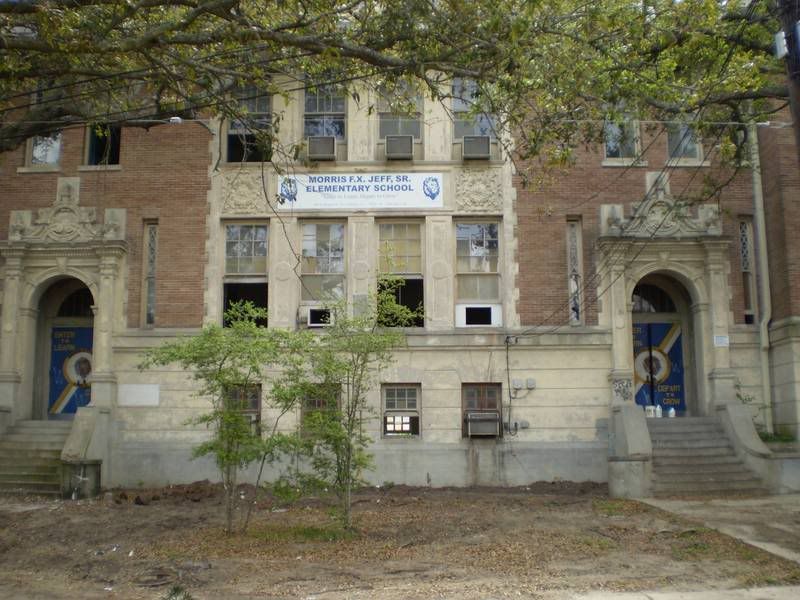
Meanwhile, this is the state of the Morris FX Jeff school in Mid City:


This picture is from over a year ago when neighbors organized to get this school repaired by the RSD, but I can assure you that the building looked the same or worse when I walked past it on Saturday on my way to the Endymion parade. This is precisely the type of building that could have been renovated had Jindal and other GOP "leaders" not been so petulant in reaction to a stimulus bill that promised to actually help people and communities around the country. And this wild post-disaster public education experiment is Bobby Jindal's crowning achievement in education policy?

"...new scholarship program..."

This part is true. Some local Democratic legislators sold out and capitulated on a school voucher program that diverts public resources away from needy public schools. But he can this one if he wants.

The bottom line is that I don't think Bobby Jindal wants to spend too much time touting his record on education. I haven't even mentioned his enthusiastic endorsement of teaching creationism in science classes.

--

I've noticed how the GOP stars have been aligning for Bobby Jindal's ascendancy to a roll as a national leader of the Party. But all that was predicated on their belief that he was capable of showing Americans that Republicans had some sort of practical vision, some policy ideas that could maybe resonate down the road when political conditions improve. Looks like they could be heading back to the drawing board on that one.

Thursday, November 06, 2008

School Facilities Master Plan Vote Tonight!!!

Go to McDonogh 35 High School at 1331 Kerelec St. at 5:00 PM sharp!

Here's a map!


View Larger Map


As briefly as I can, here's what's happening:

After the original master plan document released by the RSD encountered a diverse opposition from expected and unexpected quarters, they modified it in order to quell some of the more organized opposition groups. Some of the compromises they made are extremely important to me and I can't pretend not to be pretty happy about them:

- Carver High School is now getting a new building on site during phase 1
- Frederick Douglass, Samuel Green, O.P. Walker, and Walter Cohen High Schools will not close until 2016, giving those schools some breathing room to institute classroom stability and to coalesce an active academic community.
-Eleanor McMain, housed in my favorite building in the city, have effectively organized a renovation.

Yet, I'm still convinced that this plan falls short of our city's needs. The Cowen Institute and the Bureau for Governmental Research explained their criticisms of the master plan as resulting from the lack of funding secured beyond phase 1 of the effort. Without a concrete path to funding the rest of the plan, New Orleans could be left with extremely unequal educational facilities. Given the financial crisis and the threat of recession, there is good reason to be cautious about our prospects for funding future phases of the plan.

And here's what is meant when we talk about unequal facilities:

This is from the OPSB's own release touting the modified plan, which I've made available here.

...Phase One building program will now include 32 schools and will make it possible for nearly 60% of public school students to be in newly built or completely renovated school buildings by 2014.

That means that just over 40% of public school students will remain in inadequate dilapidated buildings or modular FEMA units a decade after Katrina.

For me, that is unacceptable.

I'd like to have a deadline for all of our public school students to be in permanent facilities and concrete funds to get there.

That might mean scaling back the district's plan for Barbie Dream Schools and instead more prudently allocating funds on targeted renovations for places like Douglass, Cohen, Rabouin, and O.P. Walker - getting our kids into stable, adequate, permanent buildings and investing our time and energy into what really matters: the classroom itself.

I think Phase 1 should accomplish those basics. Future unfunded phases should outline our greatest dreams for modern expansions, state of the art dream technology, and so on. If the RSD can rework their master plan to do this, I'll be happy to support it.

Tonight unfortunately, I expect an unanimous and unimaginative OPSB vote in favor of the master plan. We'll see.

Sunday, November 02, 2008

RSD Caving?

The RSD modified the school facilities master plan, attempting to allay the public relations nightmare sparked by the poorly conceived document and fumbled process.

The amended master plan will go before the Orleans Parish School Board later this week for a binding vote with little or no time for review by either the public or the members of the OPSB themselves.

The modifications, delaying closure of keystone high school buildings like Frederick Douglass and Eleanor McMain, awarding an immediate new building on G.W. Carver campus, and moving a few other projects from phase II to phase I, tend to allay the more vocal concerns of organized school groups and alumni associations.

Whether or not the financial concerns of the Cowen Institute or the Bureau of Governmental Research have been addressed is not clear. The RSD has certainly not secured any additional funding beyond phase I of the master plan. It is appropriate to wonder whether or not the modified plan does enough to ensure equitable school facilities if funding does indeed prove difficult to secure beyond the first phase, even when accounting for the offered changes.

My take:

The modifications signal both the strength of organized New Orleans communities and the desperation of the RSD to quickly reverse public opinion.

The process is corrupted by a quick turnaround that gives educational advocates and OPSB officials just three days to review all the changes before a binding vote. There is no public comment period for the new plan and given the reluctance of sitting OPSB members to even read the original document, it would be appropriate to give citizens the time to summarize the changes on their behalf.

Saturday, November 01, 2008

File it

In a recent comment thread, I remarked that "it's kind of difficult to gauge Pastorek's relationship with BESE. At times I've heard that there was a rift but I haven't seen any substantive evidence of that."

-

A reader passed along this interesting article from Monroe that may be significant or insignificant. Paul Pastorek has called for a criminal investigation into Monroe's Mayor and School Board, but BESE is backing off hard.

Tuesday, October 28, 2008

RSD and Alternative Schools

Some rare praise from WCBF for the RSD for this new commitment to expand support for alternative schools for our city's most troubled kids. The only issue I'd point out is that Mr. Vallas is merely expressing a desire to expand alternative programs. I'd like to see it for real, in the budget.

“They are used to getting attention for negative things,” he said. “We turn that culture around. Now they are getting attention when they do something positive. That really makes a difference in their lives at school and at home.”

Students kicked out of other schools, for offenses such as throwing knives or carrying marijuana, find new life through the RSD’s alternative program. It takes in students from every school in the area regardless of district affiliation, Haggen said.

“We are unique because we have the only judicial liaison in the area. So when kids are sent through the judicial system, they come to us,” he said.


It's important stuff.

--

And indeed Paul Vallas is negotiating a one year contract extension at the RSD. He had been expected to leave after this school year. In spite of all my criticisms, there is something to be said for continuity. I can only hope it manifests underneath as real life classroom stability.

Wednesday, October 15, 2008

Independent Groups' Concerns Over Master Plan Increase as Vallas and RSD Play the Fear Card

....This just in from the Times Picayune:

Two independent groups raised red flags about the long-term financing behind the city's ambitious and unprecedented school construction plan, and probed school officials for more details about the costs of individual projects at a meeting of the state Board of Elementary and Secondary Education Wednesday.

Representatives of Tulane University's Cowen Institute and the Bureau of Governmental Research argued that if money can not be found for later phases of the plan - which they agreed is a likely scenario -- it would exacerbate existing inequities in a city where children have long had unequal access to quality school programs and buildings.

Specifically, they said it would lead to a situation where some students attend school in state-of-the-art buildings while others remain in decrepit, outdated buildings.


There seems to be a developing consensus that this school facilities master plan is unacceptable. Wanna know why?

It's because people are using their skills of observation and logic to inform a factual reality.

And the reality is that this master plan is seriously deficient.

We close more schools than we build. The financing beyond phase 1 is nonexistent and increasingly unlikely to ever materialize. We concentrate limited resources into masturbatory wonders for the architectural class instead when the times call for a prudent allocation of resources that will get our kids into sustainable facilities as soon as possible.

But I want to discuss Paul Vallas' current talking point to the media. The company line is that we need to improve this plan as soon as possible and that any problems in the document can be fixed after the fact. Why can't the changes be made BEFORE we have to vote on the thing?

Vallas says it's because delays could result in our already-pledged funds being pulled.

"At some point we have got to start building," said RSD Superintendent Paul Vallas.

Unfortunately, I can't find a direct quote in a mainstream source but Mr. Vallas has explicitly explained that master plan approval delays could result in the loss of already-pledged monies. He made this point at the master plan public hearing at City Council.

A few points about this argument.

First, it is a typical post-K line we've all heard before about why we need to approve poorly contrived pet projects without question or debate. "WE'LL LOSE THE MONEY/REIMBURSEMENT COMPLETELY WE HAVE BUILD NOW WE HAVE TO KNOCK IT DOWN NOW SPEND NOW NOW NOW."

Second, if indeed there's a risk we might lose funding, guess who's fault it is?

The community has had this plan for less than sixty days. The RSD has been working on it since June of 2007. It was supposed to have been released last spring, then early last summer. It was finally presented to the public the week Gustav hit.

So don't feed us this BS about the delays caused by community concerns. How about the RSD planning team? How about the fact that when Pastorek saw his preliminary draft last May, he had to send the team back to the drawing board? How about the fact that even after that, Concordia-Parsons ultimately produced a document that is being widely criticized for a broad swath of structural and ideological flaws?

It ain't us that have been holding up this process - it's been them!

Third, and I think this is the real reason Paul Vallas is in such a hurry - not this empty lost funding threat - is that the deeper we get into this inevitable economic recession, the less realistic the master plan becomes. If we don't approve this thing right now, the master plan will go from being perceived as misguided, flawed, and unrealistic to being perceived as a parody of a fantasy.

This to me all seems like a bunch of 'let's move money around' horse crap. It's like how Vallas spends millions of dollars on high-tech Promethean boards for RSD classrooms when children aren't being provided with the basics, you know, like TEXTBOOKS TO TAKE HOME.

When Paul Vallas runs for governor of Illinois in 2010, as rumored, he'll get to say sexy little things in his commercials and pamphlets like:

"Spent x million dollars on state of the art classroom technology for New Orleans."
"Spent x million dollars on brand new school facilities."

Because he won't ever have to actually describe what we didn't get for expenditures that were, in reality, wasteful, premature, mis-prioritized, or worse.

Never mind that the economic crisis ensures incredible disparities in our public school system should we adopt a master plan crafted in an imagined economic vacuum. Never mind what happens when New Orleans is stuck in 2013 with what I compelled them approve in 2008.

JUST SPEND THE MONEY SPEND SPEND SPEND NOW NOW NOW NOW. YOU'LL LOSE IT IF YOU DON'T APPROVE. DON'T RISK IT. NOW OR NEVER! YOUR CONCERNS ARE UNWARRANTED. WE'LL FIX 'EM. I KNOW HOW TO FIX 'EM. JUST TRUST US. APPROVE NOW NOW NOW.

--

The Carver High School alumni association has issued a statement condemning the master plan.

Thursday, October 02, 2008

Transparent Bias by Times-Picayune Editors [Updated]

I was looking forward to see how Darran Simon's recap of yesterday's contentious hearing at City Hall in today's paper.

I found it, eventually.

Hidden all the way at the bottom of page B-1.

School-closing plan fuels council anxiety

I don't think I'm just too close to the story when I say that the upcoming vote on the facilities master plan represents the most important event involving public schools since Katrina, or at least since the decision to create the Recovery School District itself. The plan will determine the capacity of New Orleans' public school system for decades. Nobody disputes that. Nobody disputes that funding does not exist for anything beyond the first phase ending in 2013. Nobody disputes that 'landbanked' schools will likely mean demolition and/or resale. Nobody disputes that 'landbanking' is certainly synonymous with closure, even if planners allude to maybe possibly some of the closed schools one day perhaps being considered to be brought back as schools through third party operators.

Those are facts, those are the stakes. Read the article and see for yourself.

Yet, the Times-Picayune determined that this was not a top story today. In fact, the Times-Picayune made the decision that this wasn't even the top education story today. On the front cover of this morning's paper was another story about the RSD, this one about the possibility that four more schools may be turned over to charter operators. Now I'm not arguing that this doesn't merit coverage, as there are certainly people critical of the operator selection process and the ubiquitous involvement of Steven Bingler's sister-in-law's New Schools New Orleans in anything involving charter schools. But is this story nearly as important as the poorly-conceived master plan for school closure?

ABSOLUTELY NOT. It's not even close.

But let's argue for a moment that both stories are important and deserve front cover attention. The T-P could have included both stories, the one about charterization and the other about school closures, but then they would have had to bounce this life-changer that was included amongst the day's top stories instead:

Groom gets feds to snap to attention

That breaking news headline is in regard to some asshole who wore a Navy uniform to his wedding even though he'd never served. Something to note in the third hour of your midday talk radio program? MAYBE. Something for the front page of a major metropolitan newspaper on a day where the city's public school system teeters on the brink of catastrophic planning? HELL NO.

Really bad, Times-Picayune. Really bad.

--

I'd also like to challenge an assertion by Paul Vallas included at the bottom of the closure article:

Vallas pointed out that only one existing occupied building -- Audubon extension -- is scheduled to be closed in phase one.

That's simply false. Even if Mr. Vallas is trying to make the point that all of the currently-occupied schools to be lanbanked under Phase 1 won't close until the end of the phase, he's still making a false claim. Phase I of the master plan runs from 2008-2013.

Let me count them all for you.

(AND REMEMBER, THESE SCHOOLS ARE CURRENTLY OCCUPIED)

Elementary Schools - from page 90 of the official master plan.

McDonogh 07 - 2012
NO Free School - 2012
Arthur Ashe - 2012
Audobon Extension - 2012
McDonogh 28 - 2012
Dibert - 2012

High Schools - from page 94

Rabouin - 2012
McMain - 2012
Douglass- 2011

Vallas is right if he really meant that Audubon extension will be the first to be closed within phase 1 in 2010, but the currently operating Frederick Douglass High School will close soon after, in 2011. The reality is, however, that FDHS could close after this school year if doing so strikes the fancy of the school district. They are under no legal obligation to keep the school in operation and in fact, had not decided to keep the building open for this year until last May or June.


UPDATE:

But perhaps nothing reflects the editorial bias of the Times-Picayune better than their absolutely ridiculous endorsements for this Saturday's Orleans Parish School Board Race. They pick the conservative establishment choice in every instance such a choice is available. Woody Koppel over Percy Marchand? You've got to be kidding me. Brett Bonin over either Amy LaFont or Davin Boldissar? A bad joke. Seth Bloom over Avis Brock? Totally ill-informed.

The Times-Picayune pretty much endorses the most conservative Board possible, the whitest Board possible, the most anti-union Board possible, the most pro-master plan Board possible.

Percy Marchand in District 6 and Amy Lafont or Davin Boldissar in District 3 are the only OPSB candidates that have taken the time to inform themselves about the consequences of this master plan document and have been brave enough to speak out forcefully with their concerns. Woody Koppel and Brett Bonin are opportunistic insiders looking to climb the ladder. It is imperative that they be defeated.

Times-Picayune editorial board: You're hurting the recovery of this city.

Absolutely infuriating!

Tuesday, September 30, 2008

Independent Group Calls School Facilities Master Plan "Troubling"

So all the regular readers of this blog know very well where I stand on the school facilities master plan. I've been pushing this petition to extend the deadline for public comment on the master plan because the OPSB appears ready to rubber stamp the document when we know that some of them have not even read it. If you haven't, you should go sign that petition.

But maybe you're reluctant. Maybe you're saying to yourself,"That Eli is so smart and good looking. The analysis at his blog is so wise and interesting to read. But I still don't know if I should sign that petition or weigh in on the schools master plan. I don't know enough about it to know if he knows enough about it."

Maybe you'd be more convinced if my criticisms were buttressed by something a little bit more independent think tank-y. If that's the case, I urge you to see what is said in a brief from the non-profit and non-partisan Bureau of Governmental Research.

First, they agree that the consequences of accepting the document are wide-ranging and far-reaching:


If adopted, it will set the course for the development of New Orleans public schools for decades to come. It will guide decisions as to which schools are closed, which are built or renovated, and when and where.

Then, they break it down, emphasis mine:

The catch is that implementation depends on funding, and there are solid prospects only for Phase I, which has a price tag of $675 million. School officials estimate that they can cobble together between $100 million and $200 million for Phase II. But that leaves a gap of $1.1 billion to $1.2 billion for the remainder of the plan.

The Plan makes no assessment of whether this gap can realistically be funded. The section on finances merely provides a brief discussion of possible funding mechanisms. These include general obligation bonds, local property taxes, local sales taxes, sharing of facilities, state funds, federal funds, lease-purchase arrangements, sales of assets and public-private partnerships. The Plan does not provide revenue estimates for these sources, nor does it discuss the likelihood that they will materialize. School officials and planners confirmed that the planning process did not attempt to address these issues. An assessment of the financing for Phases II through VI was outside the scope of the Plan.

This is troubling. Facilities planning without a realistic assessment of financial resources for these phases is at best an exercise in visioning. At worst, it projects the illusion that all students will have access to world class schools. But, according to school officials, only half of the projected student population would have such facilities if Phase I alone were funded. The other half would not.


How does that sound for your school system? One half has while other half does not? Sounds exactly like the type of new New Orleans we all envisioned doesn't it?

So it's very serious. This is why you and all your friends should come down to City Hall tomorrow morning at 10 AM to hear testimony on the school facilities master plan. It is the public's last opportunity to provide comment on the document - which is why this petition needs to get much thicker over the next 12-18 hours. SIGN IT!

Sunday, September 21, 2008

Master Plan Truths

NOW IS THE TIME TO DIG IN


The School Facilities Master Plan for Orleans Parish is a document designed by the private planning partnership between Concordia and Parsons. It, if adopted by the Board of Elementary and Secondary Education (BESE) and the Orleans Parish School Board (OPSB), will represent the blueprint guiding the future capacity of public schools as an institution for learning in New Orleans.

- Though misleadingly billed as a "building boom" on occasion, the facilities master plan, in the word of planners, "landbanks" over 60 schools, which means that the schools will be demolished or shuttered indefinitely. Though the master plan has a rough view of schools that may be eligible for phase two construction, because there is no funding for anything beyond phase one, there is no timeline for reopening of any schools that do not receive the phase one designation.

- Some of the schools slated to be landbanked are not amongst those currently too badly damaged to be occupied by students. In fact, according to Francine Stock's incredibly useful map of the schools slated for landbanking, there are ten high school facilities currently open and serving children slated for closure by 2013. Just one of the ten academic programs functioning within those buildings is being promised relocation to another neighborhood. Those schools include such storied cultural intuitions as Carver, Douglass, O.P. Walker, Karr, Schwartz, McMain, Abramson, Rabouin, Cohen, and John McDonogh.

- Though these institutions have had their share of academic challenges, perhaps none has been more difficult to confront than those related to the traumas related to Hurricane Katrina and the subsequent displacements and relocation. These community anchors and the human beings serving inside represent a stabilizing force for recovering areas of the city. Rather than promoting stability and continuity within these already-open bridges to healing, the master plan pulls the rug out from under the talented administrators striving to institute "school reform" in the here and now. What now is the incentive for principals and teachers to implement a long term academic culture when the district is sending the message that their school programs are being written out of existence? After all that work to eliminate the baby-sitter service mentality that had set in at many schools, principals and teachers are essentially being informed that the programs they're working so hard to implement are actually themselves nothing more than placeholders for yet another academic sweep in 2013.

- Rather than embracing the urbanity of our community, the acreage requirements that inform the closure of many schools located in dense neighborhoods impose an arbitrary suburban-style benchmark that actually has no real correlation with academic performance. This design preference of Concordia-Parsons forces the school district to waste precious time and money negotiating land acquisitions and swap transactions when there are buildings open right now that could be renovated at prices cheaper than building new. Further, the suburbanized campus vision and the neighborhood school closures that the policy necessitates flies in the face of national trends predicting a re-migration to cities and the best academic research on long term environmental benefits of 're-densification' of urban cores spread thin during white flight's asphalt boom.

-Far from "agnostic in respect to operator," the facilities master plan provides no path to funding for any construction beyond phase one and explicitly raises the specter that future school capacity expansion could be left to private operators.


Readers, please treat this as a living blog post to be modified in a collaborative fashion. This is meant to represent a starting point for criticism of the facilities master plan. Please tack on additional concerns or edit those that I've opened with to be more cogent frames. By boiling down the repercussions of this master plan, we will be equipped with a helpful starting point from which to engage uninformed neighbors and confront misinformed adversaries.

So How Many Master Plan Phases Do We Have Funding For?

Please, please, please read Sarah Carr's piece that profiles the proud history of Frederick Douglass High School on St. Claude Avenue. Douglass faces certain closure under the school facilities master plan.

How many snake oil salesmen have to come storming into town before we recognize the pattern?

Installed about eight years ago, the pipes might have brought cool air to the once-magnificent, now-decayed auditorium, but the school system never found the money to complete the second phase of the project.

The unfinished effort is emblematic of scores of well-meaning attempts to breathe life into the struggling academic program in recent years. Officials have repeatedly launched reform efforts, only to abandon them before they effect lasting change.


And there are scores of other unfinished projects, even if we're limiting our discussion to the facility itself. I'm lucky enough to have gone on a tour of the building and despite the appearance of decay, it is actually quite beautiful - not so far behind most other urban schools I've ever seen. The problem has been that on countless projects both before and after the storm, crews sent out to install things like light fixtures, intercoms, air conditioning systems, and ceiling tiles don't finish the jobs. They'll do things like only connect intercoms to some parts of the building or install outdoor light fixtures but not supply replacement light bulbs. Or as Ms. Carr reports, they'll install AC pipes but no AC unit.

Teachers, principals, students, parents, and community stakeholders operated under this neglect for years and years believing that - if they could just be allowed the stability and continuity to implement a strong academic program, if they could get the confidence and support of the school board, if they could just get basic facility maintenance - they'd be able to help our children succeed.

School communities like Frederick Douglass never quit on the kids. Instead, the city quit on the school communities. How else could a nationally acclaimed writing program like Students at the Center be discouraged from returning to Douglass? Instead, Paul Vallas and the RSD are implementing an experimental "theme" school at Douglass, a police academy, for the next year before the facility will likely be shuttered.

That's not change, it's more of the same failed slash and burn policy.

When you hire visionary principles who are well qualified and highly motivated and provide them a core of career teachers committed to the program, you can slowly but surely implement a healthy learning environment, a school culture - but only if you allow that community the stability, continuity, and basic resources necessary for parents and students to buy in.

When the district threatens schools with closure, castrates maintenance budgets, and constantly shuffles principals in and out, it is only natural for a school's academic and cultural fabric to unravel.

The RSD is sitting on $1.8 billion with the promise of a few "21st century schools" to replace the scores upon scores we'll be "landbanking" for other purposes.

Amongst other things, it's installing the pipes without the units. To play with Sarah Carr's characterization of the history of Douglass, it's yet another "launched reform effort" scheduled to be "abandoned before it effects lasting change."

'Scheduled' in the sentence above is my word and I choose it for a few reasons. First, in the case of Douglass, the brand new experimental police academy program is literally already being threatened with extinction after this school year (not that I care for that experiment anyway) AND the Douglass building is slated to be closed. Second, in more general terms, there is NO MONEY for any new facilities construction projects after the completion of the first phase of the master plan in 2013.

It is very easy to anticipate that this city may need facilities expansion after 2013. First, it is almost impossible to forecast the local and national trends that may contribute to population growth accurately enough to inform binding policy. Second, Concordia-Parsons has drawn up phases 2 through 5 in the master plan, admitting that phase 1 will drain every last cent but not finish the job. Spending every last penny to do half the job? Sounds sadly familiar, no?

BESE and the OPSB are seriously considering approval for the school facilities master plan. At a time when a traumatized community of children badly needs continuity and stability from their schools, we may be about to witness the blind rubber stamping of another poorly constructed, half funded, and experimental upheaval. The master plan abandons the neighborhood school model at the high school level in favor of a system that forces kids into the unfortunately sometimes hostile territory of a neighboring ward. Ask any teacher working in the RSD about the prevalence of geographic conflict but I'm sure you don't have to.

I don't have the stomach to continue this same pattern of half-assed and poorly-informed revolution followed by yet another yawning retreat in which nobody is held accountable.

Are people as mad about this as I am?

--

RELATED:

In May, I looked at a small piece of the Parsons Corp. preliminary site assessment of Frederick Douglass High School and compared it to the school as it stood.

Liprap Leigh recaps Thursday's community testimony in front of the OPSB.

Did you know that OPSB member Jimmy Fahrenholtz, who expressed his "100% approval" for the master plan without having even read it, didn't bother to show up? He's not credible to vote on this. A lot of people tell me he's a good guy at heart but he's got no business making such a critical decision for this community if he's going to be so close minded as to not even read the document and not even pay lip service to divergent opinion. It violates public trust. We know that he is close to Steven Bingler's sister-in-law via social network and campaign contribution.

How pathetic is it that none, NOT ONE, of the OPSB members that did bother to attend was engaged enough to ask a question of the planners?

Here is the current schedule for regional master plan comment opportunities as hosted by individual OPSB members in their home districts. Two of them were today. The big event is the hearing at City Council on October 1st.

I'm still looking into how to support SOSNola's petition to extend the public comment period to January, lemme get back witcha on that.

Friday, September 19, 2008

Widespread Discontent at OPSB Hearing, Are They Paying Attention?

Because I was unable to attend this particular OPSB-sponsored public hearing on the school facilities master plan, I am relying on second-hand accounts until I can get a hold of the video.

One thing I'm trying to pin down is who did and did not bother to show up from amongst the sitting members of the OPSB. As of right now, I have reason to believe that there were one or two no-shows. Landrieu, Anderson, Sanders, Moran, and Cade appear to have been there for sure.

Additionally, I'm trying to find out who did and did not show up from amongst the many candidates vying to replace the current board and who came prepared with questions and comments.

Listen, I don't care if what you think about the master plan but it is utterly inappropriate for OPSB members to lock us into a 30-50 year master plan without listening to the concerns of citizens and independent experts. There was perfect attendance when Concordia-Parsons presented the master plan. Wouldn't it make sense to hear something other than the talking points of the hired firms?

Ideally, you'd have OPSB members avidly engaged in the hearing: asking their own questions of Concordia-Parsions, following up on concerns raised by community stakeholders, demanding clarification on waffling statements. This, regardless of attendance, did not happen.

According to witness accounts, not one sitting member of the OPSB asked a question. I'll confirm this personally upon viewing the instant replay.

And it's not as if there were no concerns voiced by the community. In fact, the crowd was very vocal about their reservations. The Times-Pic confirms this.

The Times-Picayune also relayed that SOSNola, an education advocacy group, is beginning to circulate a petition that would extend the public comment period until the new year. This would not only ensure that citizens would have the proper time necessary to review the document but might also ensure that the disengaged lame ducks of the sitting OPSB would not have the opportunity to vote on anything binding. I twice tried to contact Save Our Schools New Orleans to inquire as to how to sign the petition and to suggest they put it online. When they get back to me, I'll get back to you.

Did you make it to the meeting last night?

Tell me what you saw.

UPDATING AS WE GO:

1. G Bitch caught a brief view from local access and live blogged it:

Sandra Reed: RE the accelerated timeline for public comment, as a resident of Central City and representative of community groups, the comment period—it takes time to understand the plan and offer a informed comments, a document of this size with this kind of technical info, regular folks need time to look at it; there was a 90-day extension for the plan, “and that was no hurricane.” Will ask, “beg if I have to” to give an extra 30 days for folks to read and decipher the–

And then I believe local access cut away to something called "Traffic Time."

Thursday, September 18, 2008

School Facilities Master Plan Public Hearing

TONIGHT: 5:30 PM Orleans Parish School Board Meeting

McDonough 35 at 1331 Kerelec St.


The public comment period has been extended due to Gustav until October 1st.

BESE and OPSB have planned votes on the master plan a few weeks after that.


Sadly, I will not be attending tonight's meeting because of work. I will, however, soon have an official comment for the record completed shortly.

But everyone that can make it should go. The BESE board is likely to rubber stamp the master plan. The best chance we have to turn back this document or have it drastically modified is to exercise influence over the Orleans Parish School Board.

If you do go, please try to keep a detailed account of what is said by each OPSB member.

Here is my initial post after the release of the master plan.

Here is one on operator bias and the master plan.

Here is my most recent piece from right before evacuation.


UPDATE: My bad guys, I ta-ta-totally forgot to mention that everyone can go 'on the record' with their thoughts on the master plan by emailing them to masterplan@rsdla.net

When you do, might as well make sure to cc some witnesses.

Friday, August 22, 2008

Evaluating the School Facilities Master Plan: 3rd Grade

Let's highlight a key passage from the RSD's press release that accompanied the master plan presentation from Monday. Unfortunately I cannot find an electronic copy of what was handed out in the press packets so you'll just have to believe my transcription.


The blueprint proposes a period between 2012 and 2016 when currently occupied buildings could be discontinued if the recommendations are implemented. Any buildings on landbanked property that are in excess of 51% damaged will be demolished. Any historic property or other important or valuable buildings will be repurposed, including the possibility that these properties may be sold to third parties and used for another purpose. Landbanked or repurposed schools could be made available to third parties to revive for a school, if permission is secured from the appropriate governing authority.


Now I think this was a very interesting thing to include.

Why would third parties want to revive a school in a town where, theoretically, our brand new '21st century schools' would be meeting our educational needs?

And why would third party operators be reviving landbanked schools and not the public school system itself?

At each presentation that Parsons-Concordia has given thus far, Mr. Bingler has been very careful to say that the master plan "was agnostic in terms of operator," meaning that determinations about the future of certain facilities did not take into account whether or not the building was operated by the RSD, the OPSB, or a charter.

Yet the RSD's own press release already is already floating this idea of a future of privatized education, but you have it specifically tied to the master plan's Phase II - which has no funding.

Who would those third party operators be and which communities would they serve?

---

A brief observation from Dr. Lance Hill of the Southern Institute for Education and Research:

Note the plan plans to demolish virtually all the open-admission public schools between St. Charles and the river: Banneker Elementary, Arthur Ashe Middle, McDonogh 7 Elementary, New Orleans Free School, and Bauduit Elementary.

The school facility demolition plan has nothing to do with flood protection. Note below that the plan is to demolish schools above sea level that have never flooded (uptown open-admission elementaries), while renovating selective admission schools like Franklin and Lusher that are below sea level and did flood. The criteria is clearly not elevation.


That's very interesting because "flood protection" is the refrain I constantly hear as a justification for withholding public dollars from certain neighborhoods in general terms.


UPDATE:

From loyal reader and blogger Alli (emphasis a combination of hers and mine):

"...Agnostic in terms of operator" and "third party operators" sounds like it's in reference to this article from the NYT over the weekend:

The theorist who has had the most influence over Pastorek is Paul T. Hill, who runs a research group at the University of Washington called the Center on Reinventing Public Education. In September 2005, while much of New Orleans was still submerged, Hill published an article in Education Week that urged state and federal officials and philanthropic foundations to resist the temptation simply to send emergency aid to whatever programs seemed most in need. "The circumstances call for a coherent strategy, not just a round of do-gooding," he wrote. "Don't spend money rebuilding the old district structure."

In 2000, in a book titled "It Takes a City," Hill and two other researchers laid out a new architecture for urban school reform that they called the Diverse Providers Strategy. Under this model, local school boards wouldn't run a school system hierarchically, the way they usually did; instead, they would oversee a "portfolio" of schools, some run directly by the board and many run on contract by nonprofits, universities or private companies. Schools would receive money on a per-student basis, and principals could then use that money to staff their schools as they liked and pay for whatever instructional methods they chose. Each school would negotiate salaries and work rules directly with its teachers. The system's small central office would be responsible only for oversight, though it would have considerable power to hold principals accountable: schools that didn't produce results would be closed, and successful schools would be imitated and replicated.

It is this model that Pastorek and Vallas have adapted for New Orleans. Pastorek says that he wants the state's role to be that of a "harvester of high-quality schools" in the city — nurturing promising ones and weeding out failing ones. "If schools run into trouble, you support them," Pastorek said. "But if they're still failing after you support them, then you pull the plug and bring in a new provider or an experienced provider. Over a period of 5 or 6 years, 10 at the most, we'll have nothing but high-quality operators in our city."


Diverse Providers: Because New Orleans Has Never Had Any Problems With Contracts, Ever.


Wait, when has New Orleans ever had trouble with private contracting? What is Alli talking about?

Tuesday, August 19, 2008

Jimmy Fahrenholtz Sure Does Read Fast

OPSB member and perpetual candidate Jimmy Fahrenholtz was presented the school facilities master plan at a regular Orleans Parish School Board meeting this evening at McDonough 35 High School.

After looking it over for no more than the length of the meeting he proudly proclaimed to the Times-Picayune that he is "100 percent in support of the master plan."

That's rich because it was Jimmy Fahrenholtz who cut short Una Anderson's surprisingly strident questions regarding high school distribution uptown supposedly because tonight's meeting was only to be about determining procedure, not about expressing reservation or support.

While Mr. Fahrenholtz clearly isn't interested in hearing any public concern regarding the master plan or displaying any kind of his own healthy skepticism before taking one side over another, you'd still think he'd at least have the respect to at least sleep on the damn thing before expressing his undying enthusiasm.

Just for the sake of everyone's memory, let us recall that Jimmy Fahrenholtz is a frequent violator of campaign finance law and was very recently barred from running for Congress in District 2 due to outstanding penalties levied by the Louisiana Board of Ethics. Because those fines were levied as a result of his failure to follow the law during his race for Orleans Parish School Board, he has no business leading any kind of debate on the facilities master plan and his opinion shouldn't really be printed in the paper without the context I've provided here.

Let me mention that I can't seem to find where Mr. Fahrenholtz has filed a financial disclosure report since the storm. Also, I'll say that Steven Bingler's sister-in-law Sarah Usdin, a big education policy stakeholder in her own right, contributed to Mr. Fahrenholtz's 2004 race for OPSB. Also when Ms. Usdin was named to the Gambit's 2004 40 under 40, Fahrenholtz claims that he'd "trust her to back me up in a knife fight."

Now this simple contribution from four years ago, nor Mr. Fahrenholtz's closeness to members of the Bingler family would be a major problem except that, again, Mr. Fahrenholtz just pledged 100% approval for a plan he barely had a chance to look over.

Mr. Fahrenholtz should be excused from all debate related to the master plan and should also abstain from voting on any related binding or nonbinding recommendations. If he does not, the OPSB will have a hard time credibly passing judgment on this critical matter, particularly as voters elect replacements potentially poised to trumpet entirely different views.

This City's Implementation of CDBGs Gives Me the Heebie-Jeebies

Amongst the most important sources of federal rebuilding dollars we have available to us is Community Development Block Grants, administered through the Department of Housing and Urban Development.

Thankfully we had a greedy political hack out to reward supporters of George W. Bush running the helm at HUD and negotiating the strings of the purse we so desperately need to open.


So even though he resigned in disgrace earlier this year, the administration of our precious post-Katrina CDBG rebuilding funds has been almost entirely in his hands.

Here are three critical recovery projects we have already spent, just approved spending, or are currently proposing to spend our limited CDBG money on:

NOAH: The Mayor's Home Remediation Program

NOBC: Reinventing the Crescent

The RSD and OPSB: School Facilities Master Plan

So we're using the money allocated to help at-risk communities for fraud, profit, and to permanently castrate the city's public education infrastructure.

Brilliant.

Evaluating the School Facilities Master Plan: 2nd Grade

I have the demographic projections informing facilities master plan. The master plan is based specifically on the moderate scenario.

This document has the neighborhood-specific raw data for low, moderate, and high projections.

This document has the general summaries for each scenario.

It is interesting to note how contingent the low and moderate scenarios are on the "notion that affordable housing will not be replaced on a one-for-one basis."

-

Francine Stock has mapped all the schools to be 'land-banked' or already demolished under the master plan.

-

Thinking further about the upcoming process...

The master plan needs to be accepted or rejected by BESE and by the OPSB. The clock begins ticking on the 30 day public comment period tomorrow. Mr. Pastorek indicated that while no date has been set for a vote by either BESE or the OPSB, it would most definitely occur sometime this fall. When I heard that I assumed that the statement left some degree of wiggle room in terms of whether or not the OPSB vote would occur before or after the election. This was critical in my mind because 5 of 7 incumbents are not running for reelection and would therefore their decision on this monumental matter would not be accountable to voters. Yet I realized that if the vote is to occur this fall, it will not matter whether or not it occurs before or after the OPSB election because the new OPSB will not officially take office until 2009.

Thus, we cannot count on the OPSB vote to reflect public opinion on the master plan. Unless the RSD and the State Dept. of Education will accept waiting for the new OPSB to be seated all the way in January, the only fair solution is to put approval of the master plan directly to the voters as a ballot referendum.

-
I'll republish later with more thoughts.

Monday, August 18, 2008

Evaluating the School Facilities Master Plan

Today, the planning partnership between Parsons and Concordia released a much-hyped facilities master plan that, if approved, will guide the recovery of New Orleans public schools. I have been following this process for some time and can say confidently that the final plan is exactly what it was expected to be: a backdoor attempt to codify the smaller city size vociferously opposed by the vast majority of native New Orleanians.

The first attempt to 'shrink the footprint' was the plan released by the Mayor Nagin's Bring New Orleans Back Commission. Their prototype map of the future New Orleans showed large green dots signifying a plan to raze culturally significant and historic neighborhoods and replace them with parks. The second attempt was the toothless Unified New Orleans Plan, or UNOP. This plan was empowered to do largely the same thing as the BNOB plan, only this time with the rubber stamp of "citizen input." The citizen participation process for UNOP was lead by Concordia, an architecture and planning firm lead by Steven Bingler. From the perspective of citizens, Concordia's public participation efforts were abysmally undemocratic. Public meetings were poorly advertised and input was largely relegated to those with access to internet or fax. The idea was to create the illusion of democratic participation in order to codify the same small footprint proposed by Bring New Orleans Back Commission.

Thus, it came as no surprise when the State Superintendent of Education, Paul Pastorek selected Steven Bingler's Concordia to lead the master plan for New Orleans schools. Teaming with Concordia to assess the state of New Orleans school facilities was Parsons Corp, recently the subject of a large scale investigation after bilking taxpayers out of millions of dollars in bogus postwar rebuilding contracts in Iraq.

Presciently, education advocates in New Orleans sensed that the ultimate facilities master plan put forth by Concordia-Parsons would consolidate the capacity of the New Orleans education system by closing down and demolishing scores of former schools. Certainly, many buildings are so badly damaged that they need to be replaced, but many school sites will not be rebuilt. Everyone recognizes that population exodus from New Orleans and from public schools since 1970 has necessitated some closures, yet advocates feared that large-scale consolidations would again sap public resources away from already-struggling neighborhoods and deny those neighborhoods the services that ultimately determine whether or not it can provide for former residents evaluating whether or not to return.

The public participation process as conducted by Concordia was again suppressive-by-design. Poorly advertised, meetings featured surveys asking leading questions that reinforced the preexisting agendas of professional planners. Perhaps most damning, the Recovery School District had already begun demolishing buildings throughout the city before public participation meetings had started, rendering the process disingenuous from its very onset.

I attended what was the last public briefing on the status of the master plan and was decidedly disappointed, not by the turnout of the community, but by the efforts to prevent (or not attract) turnout amongst critical stakeholders, such as parents.

The result of the facilities master plan was finally released in Sunday's Times-Picayune.

The schools' master plan, provided to The Times-Picayune before its widespread release Monday, calls for the construction or complete renovation of 28 schools in about five years, including eight new high schools. Six of the projects included in the master plan's first phase are already under way as part of the system's "quick start" construction initiative.

Just as important, officials say, the plan would close or liquidate dozens of buildings -- for instance, cutting the number of high school campuses in half -- to create a more efficient system housed in state-of-the-art environments. All told, more than 50 existing buildings would be sold or put to new uses as part of a $1.8 billion, six-phase facilities plan designed to span three decades.


To reiterate, 52 of 125 campuses will be sold or "repurposed". Twenty eight schools will see construction. The Times-Picayune labels their map of buildings to be renovated as a 'Building Boom.' The plan is better characterized as a 'demolition depression' and might be more accurately illustrated if closures were also plotted on the map.

There is currently funding for the Phase I construction and renovation of 28 schools over the next five years. Beyond that, there is no funding to expand to more facilities, thus there is no concrete Phase II.

Students at Carver High School in the upper 9th ward, will remain in trailers until 2013 without any assurances that new facilities will ever be built on-site. Frederick Douglass High School, housed in a very solid facility on St. Claude Avenue, will close in 2011.

Thus, there is to be no high school located in the Upper or Lower Ninth Ward by 2013. There is no planned high school construction in Gentilly either. Mid-City is left out of Phase I almost entirely.

These are sustainable neighborhoods. These are culturally significant neighborhoods. But, they sustained significant damage from the Federal Flood.

Why does this keep happening?

Why is it that neighborhoods most in need of attention are so consistently being punished by rebuilding plans?

When you boil it down to its core, there was a major ideological decision made by technocrats, politicians, and/or business leaders that guides every recovery decision. This decision is routinely glossed over by professional planners and totally ignored by the media we rely upon to provide proper context.

Planners believe that services must be improved to better serve the most populated areas after the storm. This is not an improper calculation by itself but becomes regressive when one considers the practical consequences of this seemingly rational policy. In order to receive money, attention, and services a neighborhood has to prove it's viability through re-population estimates and projections. Sections of the city that were more severely damaged during the storm obviously repopulate at a slower pace and therefore do not qualify as viable neighborhoods and are subsequently enshrined as poor investments. Thus, it is the neighborhoods that did not flood (generally better-off socioeconomically) that are being provided the lion's share of recovery dollars. Neighborhoods that sustained heavier flooding (generally worse-off socioeconomically), are not seen as having a large enough population to necessitate things like roads, schools, public transportation, police, and hospitals.

For flooded neighborhoods to recover, they need these types of basic social services. In order for businesses to open in damaged neighborhoods, they need to see that people will return. For people to return, they need to see that the government will extend the courtesy of basic social services.

Various governmental agencies, all operating out of the same technocratic playbook are enshrining the continued starvation of already victimized neighborhoods for decades to come. By basing these important decision on current population estimates, they deny damaged neighborhoods with critical catalysts that might spur rebuilding and re-population, rendering future demographic estimates showing continued struggles a self-fulfilling prophecy.

Already-damaged neighborhoods starved of basic municipal services will only continue to flounder. Those still displaced from these communities will see little reason to rebuild and those that have already spend thousands to do just that will be stuck in the margins.

This accomplishes a de facto shrinking of the footprint, a de facto smaller New Orleans, and a de facto permanent displacement of tens of thousands of our neighbors.

The school facilities master plan will be a major contributor to this process. They've based their enrollment projections on demographic estimates that take into account the plans of other municipal and state agencies to emphasize or ignore certain neighborhoods. The insistence on locating schools near community assets ensures that schools will not be located in areas still struggling for access to rebuilt those basic assets.

Moments ago, I attended the media presentation of the master plan at the Contemporary Arts Center. I asked State Superintendent Paul Pastorek to what extent he believed the locations of schools facilities might impact future population patterns. He answered that he believed it would have a positive effect. I then quickly followed up by inquiring whether it then followed that the population of a community might be negatively impacted because it was not selected to receive a school. He had no satisfactory reply, stumbling toward an insistence that the master plan was not in the business of influencing re-population.

If the presence of governmental facilities, assets, and services contributes to an individual or family's decision to return and rebuild, to what extent does the absence of such basic maintenance discourage population renewal?

Did planners not ask themselves this question?

Or more macabre, did they smile at the answer?

--

Tomorrow at 5PM, the RSD will present the master plan to the OPSB in a public event at McDonough 35 High School at 1331 Kerelec St. After that, the public will have thirty days to comment. It is likely that there will be an effort to ensure the master plan is approved by the current Orleans Parish School Board. This is unacceptable because five of the seven members of that body are not running for reelection. Any binding OPSB vote MUST be delayed until the citizens have a chance to elect a new board.

Sunday, August 17, 2008

Save Our Schools

As predicted, the RSD Facilities Master Plan will indeed shrink the future capacity of our public school system to educate increased numbers of children.

Billed as a 'radical' change for our schools, I think it is more accurate to characterize what is going on as reactionary.

The whole plan is contingent on people not returning.

But without schools for people to return to, they might get their wish.

I'll talk more later today or tomorrow.

Monday, August 04, 2008

LEAP Scores Tell Us Nothing

On Saturday, the Times-Picayune published this year's set of LEAP scores for all the public school kids in Orleans Parish.

Our kids didn't do so well.

Not one school cracks above 21% "advanced" at any grade level for either math or English. The majority of elementary schools have 50% of their students or more scoring "below basic." In over half of Orleans Parish public high schools a majority of students are scoring at the lowest "unsatisfactory" level.

Over half!

But, as Darran Simon and Sarah Carr point out, some RSD officials see this year's test results as a major improvement.

...a handful of traditional schools operated by the state-run Recovery School District posted gains that catapulted them from the bottom of the heap last year to above average this year.

Particularly in the younger grades, many of the RSD elementary schools saw dramatic increases in the percentages of students passing Louisiana's standardized test. At Murray Henderson Elementary School, for instance, two-thirds of students scored at least at the "basic" level on the English test this year, compared with only one-fifth of students last year.

"We spent the entire year focused on the prize, and the prize was to do better on testing, " said Beverly Johnson-Jelks, Henderson's principal.


That's unfortunate because one thing people always complain about is this idea that over-reliance on standardized test scores as measures of academic improvement causes teachers to teach to the tests. A well-balanced education is sacrificed as critical thinking skills, the arts, civics, personal finance, etc. lose their spot as part of "the prize."

Here we have an RSD principal telling us that they did just that in order to inflate their test scores.

Another interesting thing to note, and I'm glad Mr. Simon and Ms. Carr did this in several places within the article, is that this year's test scores may not reflect any actual classroom improvements. Instead, the improved basic residential stability of Orleans Parish students and teachers may have as much to do with improved test scores than any of the "reforms" instituted by Paul Vallas.

Given the instability New Orleans children faced in the two years after the storm, and the turmoil as the Recovery District opened in the fall of 2006, some test score gains were to be expected. And despite the growth, some of the district's schools still posted abysmal scores, particularly at the high school level.

---

District officials attributed the sharp increases in lower grades to greater stability among the staff and students, as well as ramped-up test preparation districtwide.

"In the first year (2006-'07), we had so many kids coming back in October, November and December, " said Gary Robichaux, director of elementary schools for the district. "Some of the students had been in schools in different states, and some were not in school at all."

---

But individual comparisons between schools' test scores can be misleading. Some of the city's schools reopened within a year of Hurricane Katrina, while others just opened last year.


Beyond that, while one would think a comparison between this year's LEAP numbers and a school's pre-storm numbers might be more apt, staff and student upheaval renders that measure equally invalid.

And because scores were supposed to rise as a result of the return of the most basic functions (hot meals), couldn't the modest gains at only a handful of schools be characterized as a massive defeat for the RSD?

With all that hedging on the basic validity of LEAP scores as a measure of academic progress, can we say we've learned anything from this year's tests?