Mayor Nagin was criticized by some fairly recently for calling on displaced New Orleanians to misrepresent their living situations on the 2010 census to boost the city's population numbers thus leading to more federal funding where dollars are distributed proportionally based on population.
I'd support Mayor Nagin's move around census standards if he considered his displaced neighbors to be something more than a statistical prop.
I'd have his back, if his policies did something - anything - to help displaced residents return home. Remember what this man's stance toward public and affordable housing has been and continues to be.
The treatment of displaced and poor New Orleans remains antithetical to the UN's standards on human rights.
Showing posts with label public housing. Show all posts
Showing posts with label public housing. Show all posts
Tuesday, July 28, 2009
The Census Progressive


Wednesday, June 17, 2009
Sand Trap
Or should I say money pit?
As transparently insulting it is for the Louisiana Legislature to burn another $9.2 million propping up an effing golf course, the thing that makes me really ticked off is that New Orleans is proceeding full steam ahead with the construction of TWO taxpayer subsidized golf courses in City Park.
The idea behind these courses is that they'll add revenue once they lure the Zurich Classic away from TPC in Avondale.
Ummm not so much.
Seriously, is it just me or has literally every single public investment post-Katrina been an absolute joke?
I have written extensively in the past about the flawed ideology and corrupt individuals behind the redevelopment of the St. Bernard project.
Wednesday, April 01, 2009
Get Him Outta Here Already!
Speaking of disaster capitalism, I happened upon HANO's website last night. Guess who's face is still plastered all over the place?
Hint: The most consequential thing he ever built was bridge between the Bush and Nagin administrations.
He was mostly in the business of demolition and displacement and was defended by Nagin even after he resigned in disgrace for a record of politicized contracting practices, corruption, and extortion.
C'mon HANO. Take this monster off of your website. He resigned a year ago. We've had two new HUD secretaries since then.
Wednesday, December 10, 2008
The Columbia Citi Residencies at Bayou District...
Katy Reckdahl is one of my favorite reporters in town, she wrote as balanced a ground-breaking piece as you'll find anywhere. Normally, a writeup of an event like the first day of construction at the new St. Bernard redevelopment, is pure fluff. Reckdahl's mixes the enthusiasm of elected officials with the regret and skepticism of some residents.
Here's a taste:
One of the real failures of the public housing demolition debate was the inability to connect the deteriorated conditions of the Big Four to the decades of incompetence and intentional neglect by HANO. It's interesting to juxtapose residents' complaints about official inattentiveness to the old solid brick structures with the new construction of flimsy suburban style townhomes. It's not exactly much of a stretch to imagine yet another iteration of the same construct - neglect - demolish - construct spin cycle.Former residents alternately spoke lovingly of the bricks that had sheltered them and decried a woeful lack of maintenance in the past by the Housing Authority of New Orleans, of mildew, inoperable plumbing and hunks of peeling paint that left many children with heightened lead levels in their bloodstreams.
Longtime St. Bernard resident leader Naomi Minor sent many letters about the buildings' poor conditions before Hurricane Katrina hit, and she supported the idea of a rebuilt complex that would be a safer place to live, she said.
Kowana Lyons, 34, who had lived her entire life at the St. Bernard complex, agreed that the decades-old buildings had deteriorated. But she was too fond of what she called "our bricks" -- the solid concrete and brick structures -- to embrace the new development's side-by-side townhome designs, which struck her as flimsy by comparison.
But Reckdahl does leave out some important context. In a separate Monday piece, she goes into some detail about residential enthusiasm for the redevelopment of Lafitte, which is preserving more historic structures and providing real one-for-one replacement of units. It was kind of ironic that the complex I most wished to keep also happens to have the most just and comprehensive redevelopment plan. (Of course Mary Landrieu and the entire Louisiana Congressional delegation tried to mandate one-for-one unit replacement in the Gulf Coast Housing Recovery Act but this effort failed. The only opposition to that bill from local officials came from David Vitter and Stacy Head.)
That article did go into the stats, in terms of how many of each type of unit would be built at each of the redevelopment sites. But today's piece, which focused solely on St. Bernard didn't go into the details in terms of what's expected at the end of construction. If there's one redevelopment project that demands extra scrutiny and context, it's St. Bernard, er excuse me, The Columbia Citi Residences at Bayou District. If Reckdahl had gone into more detail, she would have been more or less obligated to mention the real controversy hanging over Columbia Residential and the Bayou District Foundation.
The reasons to be skeptical of Columbia Residential's redevelopment plans were enumerated by the Times-Picayune sometime in 2007 but were subsequently ignored throughout the rest of the public housing debate. Anybody remember a man by the name of Alphonso Jackson?
No article about the redevelopment of St. Bernard should exclude at least a couple of contextualizing sentences about the controversy dogging how the contract was awarded to Columbia Residential and about the larger plans of the Bayou District Foundation to link the whole project to the redevelopment of golf courses in City Park.
Thursday, November 20, 2008
HANO Destroys More Houses
The list of 500 properties includes more than 50 units at HANO's Christopher Park development on the West Bank, another 50 at the Press Park development in the Desire area, dozens in Gentilly and in the Irish Channel, and hundreds in eastern sections of the city and in the Lower 9th Ward.
The targeted properties have been untouched since Katrina, despite Walker-Woodfork's personal campaign for a restoration program. For at least the past year, Walker-Woodfork has addressed the HANO board at each monthly meeting with a list of scattered-site addresses in her hand.
"Can you tell me when Imperial Drive will be rebuilt?" she would ask. And she would similarly ask for information about plans for Dale Homes, Painters-Lesseps and other residential developments in the HANO inventory.
Once, the board chair told her that she'd asked the exact same questions the previous month.
Walker-Woodfork said that she was asking the same questions because she "never got any answers."
On Wednesday, Walker-Woodfork said she and other residents had met with HANO before the board meeting and had seen the list of homes to be demolished. She was glad to at least know something about the fate of the properties, after three years of asking questions.
But she still has no repair timetable for the remaining scattered-site inventory, saying she has only heard of plans for repairs to about 40 apartments.
Stall, stall, stall, then demolish, then come up with a plan to house people.
Friday, September 12, 2008
Monday, July 07, 2008
Right of Return Lip Service Trumped By Bureaucratic Practice
Just in case you missed it, Katy Reckdahl wrote an essential piece for yesterday's paper. It is absolutely critical reading for anyone that has been following housing and the plight of displaced New Orleanians who, by the way, still number in the hundreds of thousands.
Through the experiences of two displaced New Orleanians, the article details the inability or refusal of HUD to close bureaucratic loopholes that allow local housing authorities to refuse to pay to transfer residents back to New Orleans due to higher rent.
This has caused a standoff between HANO and housing authorities in other cities, particularly in Texas, which took in many Katrina evacuees. The Housing Authority of New Orleans can't afford to pay for any incoming vouchers, said HUD spokeswoman Donna White. So many out-of-town housing agencies -- facing the prospect of paying rent for all transferring vouchers -- have invoked the "higher rent" exception to refuse New Orleans transfers, including Martin's and Egana's.(Never mind the fact that HANO is under the direct control of HUD)
Let's take this opportunity to remind ourselves of HUD's record in New Orleans and around the country over the last 7 and a half years.
While there is both corruption and incompetence, let us not overlook the troubling ideological ends reached as a consequence of bureacratic inaction.
Wednesday, June 04, 2008
MUST LISTEN - A Rare Crossover Event
You must must must listen to this NPR report on housing and hurricane preparedness. Why are so many people living in formaldehyde-contaminated trailers? Why isn't there adequate permanent housing? What would the temporary housing situation be in the event of a Hurricane today?
"this is life and death"
It stars two agencies I talk about a lot, this time in the same episode. It's like when the cops of Homicide: Life on the Streets went and did some investigating with the Law and Order guys.
The only difference is that on those fictional shows the cops were solving murders, while in this real life situation, government agencies are committing them.
h/t: Karen
Thursday, May 22, 2008
The Most Glaring Difference Is What?
Let's play a little game. There are two sets of photographs below. All of the buildings pictured are in the city of New Orleans and they all resemble one another architecturally.
Look at these photographs: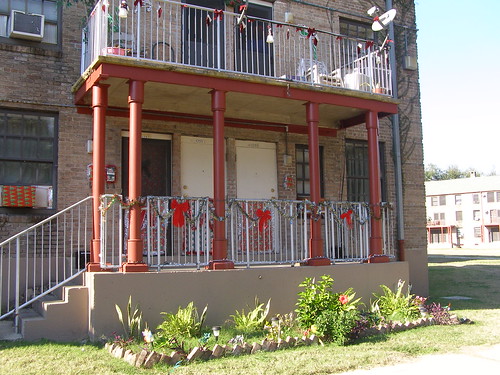
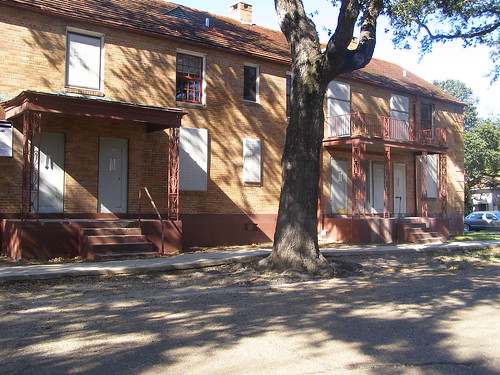
Now look at these photographs:

What are the differences between the buildings above and the buildings below?
Well one set of buildings is an original while the other is a replica.
One set was built with cheerful red brick while the other is made from depressing gray.
One building set is of historic and cultural value to the New Orleans community while the other is not.
The structures in one photo set have been demolished while the buildings in the other still stand.
--
To me, there is one difference between the two sets of buildings depicted that is more troubling than all the rest. What do you think it is?
Friday, May 16, 2008
Par 5, Split Fairway
This is the fifth part of my series called Demolishing and Redeveloping Alphonso Jackson.
I wanted to leave that out of the title because this post extends Jackson's reign at the Federal Department of Housing and Urban Development very concretely to the city of New Orleans. It's not just about him because of its consequences for us.
In part 1, I describe how Alphonso Jackson not-so-subtly explained to minority vendors that contracts from HUD would be awarded partially based on the political affiliations of the bidders.
Part 2 briefly describes how the city of New Orleans lost independent dominion over the Housing Authority of New Orleans, how HANO came to be under the direct control of HUD.
The scandal that most directly brought about the resignation of Alphonso Jackson resulted from his actions against the Philadelphia Housing Authority. In part 3, I detail the spat between minority developer and Republican contributer Kenneth Gamble and PHA's Executive Director Carl Greene. Gamble, after failing to meet the terms of his non profit's contract with the PHA, called in Alphonso Jackson to intervene. When Jackson and his people at HUD began to retaliate against Philadelphia by attempting to withhold federal funding, Carl Greene filed suit. The suit became public and the heat of the subsequent congressional investigations prompted Mr. Jackson to resign.
In part 4, I interviewed PHA Executive Director Carl Greene in detail about his experience with Alphonso Jackson and HUD. He had some impressive insights into the public housing demolition controversy from late last year and spoke to the problems that arise as a result of ceded municipal authority.
Why have I been slowly releasing research on Alphonso Jackson and HUD? What does it all mean? How does the scandal in Philadelphia tell us about New Orleans?
I hope to connect the dots for you today. I will draw a lot on the previous four posts of the series to help illustrate the big picture. I encourage you to read those if you can but I hope that this is clear enough to stand on its own.
I can tell you now that this is going to be really long, but I promise it'll be worth it. Take your computer into the bathroom with you.
--
Most rewarding thus far, was my interview with Carl Greene. I had hoped that discussing his legal authority to file suit against HUD on behalf of the residents of Philadelphia's public housing would help illuminate the problematic alliance between HUD and HANO in the housing decisions that have occurred here.
Mr. Greene was willing to be so forthright with me about his view of things. His perspective on the operational philosophy of Alphonso Jackson was thought-provoking and was way more frank than I had envisioned when I contacted his office.
There was one thing that really had me thinking for some time after I'd posted the interview.
Now, Mr. Greene of course knew firsthand about Jackson's favors for socially connected elite African American business people through HUD's attempts to retaliate against the Philadelphia Housing Authority on behalf of 2000 RNC speaker and Republican donor Kenneth Gamble.
. . . I think Alphonso Jackson somehow felt as though he was the king of black people and his job was to somehow [benefit] these black contractors at the expense of the law. . . . [I]t's not just African American because I don't think it's just about black. I would say black-hyphen-socially-elite black. There's still a lot of poor black people out there that I'm in the business of serving every day. [Jackson] wasn't doing nothing for them. He went to Congress and said 'oh yeah give them 75%, give them 76% funding, take away all of their money.' But on the other hand, for one guy who can make some records, or some guy that makes contributions, or some guy that hangs out at the right golf club, I mean, the whole socially elite type that he was interested in - he would sacrifice the whole program for the purposes of benefiting the social elite. And that's what it came down to. It came down to the self-ascribed country club social contacts that he had, and he didn't care about the rules when it came to these folks.
--
I think Jackson was left to his own discretion to do whatever he wanted at HUD and he used that discretion - he abused that discretion - to take care of business and personal friends who became part of an elite social and business network. This was done at the expense of the city of New Orleans and its Housing Authority and if the City Council or the Mayor tried to object then he could always threaten to withhold the money or not give the money. [T]hat was his normal M.O. 'If you don't go along with me then you won't get the money.' It's a 40 billion dollar agency and he's doling out money - he used it as a political weapon to force you to go along with his policy. With the compromising of the political infrastructure [in New Orleans], you had a guy [Jackson] that was in charge of the agency who would beat you over the head with the power of his office if you didn't really vote the way he wanted you to vote on the demolition application, so, effective advocacy for the very very poor folks down there, an effective, professional housing advisory to the Mayor and the Council and the housing authority board was not present. [H]e kind of hijacked that for his office and made it an organization that put on a front of taking care of affordable housing and public housing when at the same time, it was always the people that were part of the social and business elite crowd that he was associated with, that were getting the work.
But there was something else there that really stuck out in my mind and it took me awhile to really put a finger on what it was.
I had to think on it.
-
Stroke 1: The philosophy of black capitalism as applied in New Orleans
Black capitalism in general is not bad or dangerous at all. In fact, I like it. Basically, it argues that for African Americans to rise as an oppressed minority, they must accumulate wealth by building their own businesses. Essentially, it's a large-scale "buy local" campaign to keep African American money in the African American community and away from large corporations that contribute to the larger economic system that has cemented aspects of structural racism.
In some instances, however, some African American business leaders have lost their way. They come to exploit the African American communities they purportedly assist by obtaining wealth. I can even see the justification. For example, though Kenneth Gamble was bilking Philadelphia Housing Authority residents, most of whom are poor African Americans, by failing to build the houses his contract with PHA demanded, he could sleep at night because the profits he and his company received from the market rate development he wanted to build would remain in African American hands - his own.
Now let's take a New Orleans example.
In early November, the Times-Picayune wrote about our sanitation contracts with Richard's and Metro disposal. I think everyone remembers that one, it sparked a lot of outrage and a City Council investigation. The gist was that two minority-owned sanitation companies, Richard's Disposal and Metro Disposal, were receiving suspiciously cushy treatment from the city. While Jefferson Parish receives full sanitation service including "unlimited bulky waste" for about $8 from each taxpayer, New Orleans tax payers receive less service for at least $10 more per resident.
Additionally, as you'll recall, the original contracts with Richards and Metro actually did call for the removal of all "unlimited bulky waste," but after the fact, Nagin drafted an amendment that was sponsored in Council by Cynthia Willard-Lewis that eliminated this requirement from the contract.
*To be fair, Councilwoman Willard-Lewis' amendment was approved unanimously by all members of City Council, save for Stacy Head, who was not present. Councilwoman Head has an ideological opposition against funding certain city services for residents and believes that the city should not pay for debris removal at all. This reflects very poorly on the functioning of Council as a whole and on the individual culprits.
Of course, Richard's and Metro are owned and controlled by Alvin Richard and Jimmie Woods, respectively. Since 2006 alone, Richard's and Metro, or their owners or partners, have given thousands of dollars to the campaigns of Ray Nagin and Cynthia Willard-Lewis.
That's not the end of the story, however. As you might remember, when City Council got around to investigating their prior mistake, Richard's and Metro organized a protest of chambers. They alleged that the investigations into their contracts, which were quite clearly taking advantage of the population of New Orleans, amounted to racism against minority-owned firms. They stacked council with their employees and brought in officials from what could once be called a civil rights group, SCLC, which threatened a comically ridiculous boycott of the city.
Never mind that the inflated garbage collection contracts were hurting predominantly African American New Orleans taxpayers, our neighbors most disproportionately hurt by any form of economic exploitation or tax revenue waste. Never mind that a boycott by any group would disproportionately harm African Americans at the bottom rungs of the service industry economy. The warped interpretation of the black capitalism philosophy allowed Cynthia Willard Lewis, Sanitation Director Veronica White, Ray Nagin, Jimmie Woods, Alvin Richard, and Spiver Gordon of the SCLC to sleep well at night because they were working to keep the money in the hands of African Americans: two sets of hands, those of elite African American multimillionaires Alvin Richard and Jimmie Woods.
Stroke 2: Alphonso Jackson and William Hairston in New Orleans
While HUD Secretary Alphonso Jackson's retaliation attempts against the Philadelphia Housing Authority yielded the political pressure that ultimately caused him to step down, Mr. Jackson was also under investigation for his role in steering contracts to his friends here in New Orleans. In October, the National Journal's Edward Pound reported on some nefarious relationships between Mr. Jackson and the firm that ultimately won the contract to redevelop the St. Bernard housing complex. The Times-Picayune also picked up the story. The allegations, at that time and as they developed, were two-tiered.
First, Alphonso Jackson was accused of steering a no-bid contract via HANO to millionaire African American businessman William Hairston to the tune of close to $500,000 for work done as a construction manager over an 18 month period. Later, Edward Pound found that HSD, a Georgia company affiliated with Hairston received an additional $186,000 contract directly from HUD.
So who is William Hairston?
According to Pound, he is:
"a golfing buddy and social friend from Hilton Head Island, S.C."
Hilton Head Island, South Carolina, of course, is an extremely exclusive residence and elite vacation destination, where, according to the New York Times, Alphonso Jackson purchased a home in 2004. Hairston's wife, Starletta Hairston is currently running for the SC House from Hilton Head Island as a Republican.
Remember Mr. Jackson's contracting philosophy, as relayed to a conference of minority real estate executive in Dallas, from Part 1 of Demolishing and Redeveloping Alphonso Jackson:
"I said, 'What do you mean?' He said, 'I don't like President Bush.' I thought to myself, 'Brother, you have a disconnect -- the president is elected, I was selected. You wouldn't be getting the contract unless I was sitting here. If you have a problem with the president, don't tell the secretary.'
"He didn't get the contract," Jackson continued. "Why should I reward someone who doesn't like the president, so they can use funds to try to campaign against the president? Logic says they don't get the contract. That's the way I believe."
Here is a list of political contributions by William and Starletta Hairston over the years. I'm sure that there are more listed under Mr. Hairston's various business ventures.
(Democratic majority whip James Clyburn also plays golf with Jackson and Hairston and also has questions to answer about his role in steering the HANO contract.)
Stroke 3: Alphonso Jackson and Columbia Residential in New Orleans
Columbia Residential is the company contracted for $127 million to redevelop the St. Bernard housing complex. Its President, Noel Khalil is a multimillionaire African American contractor from Atlanta.
According to the Times-Picayune, Columbia Residential via its subsidiary Columbia Highlands LLC had history in New Orleans before the storm:
Last December, a Columbia Highlands employee pleaded guilty to accepting bribes from a HANO contractor he was supposed to be overseeing. According to a summary of the case filed by the government, James Lozano of Atlanta admitted accepting $45,000 from the owner of a construction company helping to build the Fischer Senior Housing Village in Algiers. The money was paid in increments starting in 2002, the records say.
Columbia Highlands initially received a small project management contract from HANO, Moon said. In late 2002, the firm got a much larger contract, essentially putting it in charge of overseeing the redevelopment of all of the complexes undergoing renovation at the time: Desire, Florida, Fischer and Guste. The value of that contract could not be determined Thursday.
Moon said the larger contract was awarded after a competitive-selection process, under which HANO would not have been bound to choose the lowest-priced vendor. She declined to continue the interview after being asked how Columbia Highlands first came to work for the agency.
Remember, HANO was directly controlled by HUD beginning in 2002.
Turns out, Alphonso Jackson and Noel Khalil are close:
At the same time, the secretary still has financial ties to one housing developer. According to Jackson's financial disclosure reports, an Atlanta-based development company, Columbia Residential, owes him $250,000 to $500,000. Before joining HUD, his spokesman said, Jackson was a "partner/consultant" for the developer.
According to his disclosure reports, Jackson is to receive periodic payments "for past services" under a separation agreement with the company. He has received only one such payment in the past six years -- $35,000 in 2003. HUD officials said that Jackson avoids any dealings with Columbia Residential. They released a memo he wrote in August 2001 in which he recused himself from HUD matters having "a direct and predictable effect on the ability or willingness" of the company "to satisfy its obligation to compensate me for prior service rendered."
Columbia Residential's $127 million contract to redevelop the St. Bernard projects was, of course, above-board because Mr. Jackson has agreed recuse himself from the panel that awarded the big four redevelopment contracts?
The four-member selection panel included Scott Keller, who was until recently Jackson's deputy chief of staff and who is often described within HUD as Jackson's "right-hand man." But in an interview, Keller said that because of the press of other HUD business he did not participate in, or influence, the selection of the Columbia Residential team. Keller left HUD in August to become a private consultant.
Nothing to see here, other than a follow-up by Pound that explains how Mr. Keller became a central figure in the investigations into HUD.
As it turns out, however, Keller not only helped choose the panel but also served as a member. The other panel members were another senior HUD official from Washington, a HANO official, and an executive from the Fort Worth, Texas, housing authority. Legal and financial advisers assisted the panel in the selection process.
According to three people with intimate knowledge of the selection process, Keller strongly favored the Columbia Residential team's proposal. Margaret (Peg) Stone, a private financial adviser who is now retired, sat in on the discussions and recalls that Keller promoted Columbia Residential's plan "from the beginning." Stone said: "He certainly liked them a lot.... He advocated strongly for the best solution to the project, which he thought was Columbia Residential."
Khalil, a registered Democrat and donor, certainly knew how to play ball the Alphonso Jackson way in 1999 when he contributed to George W. Bush's first-term campaign.
So to quickly sum up, Noel Khalil of Columbia Residential won a $127 million contract from the taxpayers of New Orleans after formerly employing Alphonso Jackson, who used his chief of staff to pick and serve on the panel that awarded the contract. Columbia Residential continued to make direct payments totaling at least $250,000 while Mr. Jackson served at HUD.
Stroke 4: Columbia Residential, Bayou District Foundation, and St. Bernard
A 501c3 nonprofit, the Bayou District Foundation, came to be the public face of the complicated web of companies and foundations working on the St. Bernard redevelopment:
St. Bernard Redevelopment is the same group of nonprofits and businesses that have struck a partnership that includes the Fore!Kids Foundation and the Baton Rouge Area Foundation, both established charities.An affiliate of the Baton Rouge Area Foundation, Commercial Properties Development Corp., will manage commercial elements of the redeveloped St. Bernard site. A for-profit Atlanta company, Columbia Residential, will develop the apartment complexes. The Bayou District Foundation, formed earlier this year, acts as the public face of the complex partnership.
The Fore!Kids Foundation? I thought this was about building houses.
Why build affordable housing in a city with an affordable housing crisis when you can risk it and try to reach the green in two?
So the Bayou District Foundation is asking park officials to give up a portion of future revenue in exchange for the foundation's massive front-end investment in three golf courses, two of them of a quality that could lure PGA Tour events to the city. The foundation has proposed taking $500,000 from an expected $1.5 million in yearly golf revenue to finance educational and recreational programs at the St. Bernard complex. The plan's backers say they will assure City Park retains at least $500,000 in golf revenue.Nope, no annoying residents to ask questions, the storm took care of them. Now that we have the backing of Federal housing official (Alphonso Jackson) that our primary housing partner (Columbia Residential) owes hundreds of thousands of dollars, we can just go ahead and build two PGA-caliber golf courses.
-
Despite the obstacles, businessmen pushing the foundation plan have high hopes. Federal housing officials have endorsed the developers' broad vision. And the complicated agenda has advantages created, oddly, by Hurricane Katrina.While they face criticism and questions from displaced St. Bernard residents, the Bayou District Foundation leaders don't face the wrenching prospect of relocating people. The more than 1,000 families living in the 52-acre complex before Katrina flooded the neighborhood are gone, and St. Bernard is shuttered.
It gets even more ludicrous:
Golf and public housing may seem like odd bedfellows. But the plan uses as its model Atlanta's East Lake housing and golf development that replaced a notorious Atlanta public housing complex with what by all accounts has become a thriving mixed-income neighborhood. That unique project taps the golf revenue to finance education and recreation programs for families in subsidized housing.But, the as that TP article indicates, there are two key differences. First, the Bayou District Foundation's plan will cost at least $240 million whereas the East Lake plan cost $128 million. The other difference is kind of shrugged off in the article, but I'm going to highlight it because it's actually a huge difference:
The New Orleans effort lacks a local "sugar daddy," a philanthropist like Atlanta's Tom Cousins, who spearheaded that project after buying and restoring the storied East Lake Golf Club. And so the proposal will have to rely more heavily on nationwide fundraising and federal financing.Atlanta's East Lake development was financed by a single philanthropist! Our plan relies on taxpayer money and public lands. That's a huge difference.
"This is not a New Orleans fundraising effort. It has to be national," said Gerard Barousse, a real estate executive and managing partner of the Bayou District Foundation. "He (Cousins) told us he will introduce us to people, make some calls."Genius! Not only are we going to melt our affordable housing tax dollars with a golf course redevelopment plan, but we're also going to rely on our big brother Tom Cousins to introduce us to his friends?
Well, Mr. Barousse, how's that fundraising effort going?
From an April TP story:
The rapid decline in financial markets has upset plans developers made last year to remake the public housing developments with a mix of public and private money. Since the City Council voted to demolish the complexes late last year, a spiraling credit crisis has made banks uneasy about making new loans. Meanwhile, the value of low-income housing tax credits that will be used to finance the projects has declined.In recent weeks, the Louisiana Housing Finance Agency, the state entity handling the award of tax credits, has said that any affordable housing developers who have not yet closed on their financing plans may find themselves unable to do so.
-
Gerard Barousse, managing partner of the Bayou District Foundation, which is redeveloping the St. Bernard complex, said the market has gotten tougher, but he hopes to close on financing in July and begin construction at the end of summer. "There's a little bit of a gap that we're working with, but it's not an insurmountable number," Barousse said.
But Bayou District is still shopping for a lender and tax credit syndicator, making it harder to nail down figures. "We're still sorting through a lot of that," Barousse said.
So it's not working out so well? What happened to all of Tom Cousins' friends that you were going to get introduced to?
Stroke 5: Saving for Par?
Let's once again revisit the words of Carl Greene of the Philadelphia Housing Authority:
. . . I think Alphonso Jackson somehow felt as though he was the king of black people and his job was to somehow [benefit] these black contractors at the expense of the law. . . . [I]t's not just African American because I don't think it's just about black. I would say black-hyphen-socially-elite black. There's still a lot of poor black people out there that I'm in the business of serving every day. [Jackson] wasn't doing nothing for them. He went to Congress and said 'oh yeah give them 75%, give them 76% funding, take away all of their money.' But on the other hand, for one guy who can make some records, or some guy that makes contributions, or some guy that hangs out at the right golf club, I mean, the whole socially elite type that he was interested in - he would sacrifice the whole program for the purposes of benefiting the social elite. And that's what it came down to. It came down to the self-ascribed country club social contacts that he had, and he didn't care about the rules when it came to these folks.
--
I think Jackson was left to his own discretion to do whatever he wanted at HUD and he used that discretion - he abused that discretion - to take care of business and personal friends who became part of an elite social and business network. This was done at the expense of the city of New Orleans and its Housing Authority and if the City Council or the Mayor tried to object then he could always threaten to withhold the money or not give the money. [T]hat was his normal M.O. 'If you don't go along with me then you won't get the money.' It's a 40 billion dollar agency and he's doling out money - he used it as a political weapon to force you to go along with his policy. With the compromising of the political infrastructure [in New Orleans], you had a guy [Jackson] that was in charge of the agency who would beat you over the head with the power of his office if you didn't really vote the way he wanted you to vote on the demolition application, so, effective advocacy for the very very poor folks down there, an effective, professional housing advisory to the Mayor and the Council and the housing authority board was not present. [H]e kind of hijacked that for his office and made it an organization that put on a front of taking care of affordable housing and public housing when at the same time, it was always the people that were part of the social and business elite crowd that he was associated with, that were getting the work.
I've been thinking about what this all means for the city and for the children displaced by Hurricane Katrina and subsequently abused by the affordable housing crisis. It's just so shameful. Not only was Alphonso Jackson executing an increasingly blatant agenda to enrich his elite friends with lucrative HUD contracts or other favors using his political muscle, but our local leadership seemed something more sinister than ambivalent.
They seem complicit.
The racial implications of this are uncomfortable. We have a situation in which Alphonso Jackson and his friends, like Ray Nagin and his friends, have achieved a monetary and social status reserved for a select few.
Golf is symbolic in this sense. It is an exclusive game, a sport with prohibitive membership costs. To get in, the Mayor and his friends and Alphonso Jackson and his friends sold their souls. Their policies and practices have hurt the very communities they purportedly began careers in public service to assist.
Now they serve a different community. They serve Gerard Barousse of the Bayou District Foundation. They serve the Bayou District Foundation's design and construction team (click on 'management team'): Broadmoor LLC is a subsidiary of Boh Bros. Construction.
Now certainly there can be an argument made that the ascent of elite African American business people to country club status is an inspiring feat. Certainly those behind the Fore!Kids Foundation have a stated intention to make golf more accessible to a demographic historically barred from the game.
But I wonder if it's a game worth playing at all. I wonder if it's a game worth teaching our youth. And I'm not talking about golf the sport, I'm talking about the game played by the likes of Alphonso Jackson, Ray Nagin, Jimmie Woods, Alvin Richard, and William Hairston.
Is it really worth teaching a select few how to achieve "success" in a game systematically rigged to prevent the vast majority of their peers from ever playing? Especially when "success" relies upon one's ability to use that exploitive system for one's own selfish benefit at the expense of the larger community.
And that's ultimately what is happening with the St. Bernard redevelopment plan and with the city's larger affordable and public housing non-policy. Rather than address the incredible challenges that ordinary people face every single day in this city and the incredible risks to this city's long, medium, and short term viability, our state, local, and federal leadership has instead adopted a backward trickle-down approach to community development.
Let's not build housing or raise the minimum wage or provide hospitals or schools or public transportation.
Instead let's put up hundreds of millions of dollars for a "vanguard" river redevelopment and promise that the eventual revenue fallout will drip down to residents.
Instead let's demolish salvageable public housing units and install market rate homes to be sold at a profit with the promise that this will help spread neighborhood revival down the road.
Instead let's build three new golf courses and promise that the social benefits of accessibility will allow a few hundred to maybe learn sportsmanship and integrity. We promise that the small business economy will develop as soon as we can get PGA tour events to bring more high end business here.
NO NO NO NO NO.
They want to snooker us into believing that the economic development that follows upfront investment in ventures by and for elite business interests will eventually provide enough tax revenue to then go ahead and invest in the social services and infrastructure necessary to help middle and working class New Orleans families.
That's not what happens. Any increased tax revenue that might arrive will only be reinvested into another chic development project like a new stadium for the Saints or into tax abatements for more luxury condominiums.
That's why you say no right now.
All that initial startup investment they want to shower upon these wealthy developers, contractors, and construction companies might foster more economic development and eventual tax revenue if they put it into the programs, services, and infrastructure that we're frustrated with every day. Maybe instead of investing in a golf course that might eventually entice wealthy golfers to play here, the smarter strategy would be to directly invest into the community so that families will actually want to live here.
-
This week, we learned that our fearless President "gave up" the game of golf out of deference to military families suffering through the frustration of a difficult war sometime in 2003.
Yet, at the same time, President Bush's friend Alphonso Jackson was rounding up his own golf buddies for a Katrina aftermath tee-time.
Thursday, May 01, 2008
Demolishing and Redeveloping Alphonso Jackson: Part 4
I've been doing all sorts of research on Mr. Alphonso Jackson, former secretary of HUD.
He resigned recently as his office was bombarded by allegations of cronyism and political retaliation.
In Part 1, I described Mr. Jackson's illuminating speech to minority real estate investors in which the Secretary warned potential contract bidders against speaking negatively of the President. I discussed the result of the investigation into his comments: Jackson's own employees testified to Congress that the Secretary had indeed instructed senior staff to look at potential contractors' political orientation.
Part 2 briefly discussed the end of municipal authority over housing in New Orleans. HUD officials took over the Housing Authority of New Orleans in 2002.
Part 3 delved into the scandal that most directly brought about Mr. Jackson's resignation. HUD had been systematically retaliating against the Philadelphia Housing Authority for the agency's refusal to hand over a valuable parcel of land to a well-connected developer who had built only 80 housing units out of 236 required by his contract with the city. Kenneth Gamble, the developer and political player, had cultivated relationships with officials from both parties throughout a long career. However, exclusive WCBF research uncovered that Mr. Gamble had been stringently abiding by Mr. Jackson's advice to minority business contractors. After delivering an address to the RNC in 2000, Mr. Gamble gave exclusively to Republican Congressmen from late 2001 through 2004. When PHA determined that Gamble's nonprofit had failed to meet the terms of its contract, the developer made a personal appeal to his friend at HUD. Alphonso Jackson was willing to hold the entire Philadelphia Housing Authority and its residents hostage by withholding federal money in an attempt to extort a valuable parcel of land to reward a loyal minority contributor.
It was the fallout from this game in Philadelphia that ultimately caused Jackson to step down. Carl Greene, the longtime executive director of the Philadelphia Housing Authority collected the various telephone and email threats from HUD staff over the course of the land dispute. PHA's lawsuit against HUD blew the various allegations of Jackson's improprieties onto the front pages of newspapers and into the consciousness of Congressional investigators. While various allegations had dogged Mr. Jackson for business dealings in the Virgin Islands and in New Orleans, it was the spat with PHA that seemed to bring down the Secretary.
Earlier this week, the Executive Director of the Philadelphia Housing Authority, Mr. Carl Greene was kind enough to speak with me directly about the scandal that brought about the resignation of Alphonso Jackson, his experience working with HUD during the Bush administration, and his view of public housing in New Orleans.
"One thing that came out of one of the depositions that were conducted of some of the HUD staff people was things related to time spent talking to New Orleans, the mayor of New Orleans, and [Jackson] being on the phone with the mayor of Philly or people in Philly. Jackson was directly involved in both cities for different reasons."
"The challenge to him in Philadelphia was that we were our [own] housing authority with administrative control. With the situation in New Orleans, HUD hires and fires the staff. . . He was able to replace [local] people directly. Whereas, in Philadelphia, I really don't work for HUD. I work for a board. I don't work for [Jackson]. He sort of, I think, got a little carried away with himself."
". . . His perception of his power and his influence may have gone to his head with respect to New Orleans and the Virgin Islands because he had control of those housing authorities. . . Therefore, all he had to do was pick up the phone and make some phone calls and get people to do things. Whereas in Philly, when he did that, I refused to go along with it."
I was impressed with the manner in which Mr. Greene used his administrative independence from HUD to expose their efforts at retaliation. HUD was threatening to withhold federal funds for what they claimed was PHA's failure to meet a minimum federal standard of 5% units reserved for disabled persons. To Greene, who is also African American, Secretary Jackson had an agenda designed to serve minority contractors willing to become socially and politically connected with the Republican elite in Washington.
"We did our own independent survey of independent architectural firms to go out and measure every unit - and we have 8%. But they [HUD] didn't want to let the facts get in the way of their vendetta. I think Alphonso Jackson somehow felt as though he was the king of black people and his job was to somehow [benefit] these black contractors at the expense of the law.
". . . [I]t's not just African American because I don't think it's just about black. I would say black-hyphen-socially-elite black. There's still a lot of poor black people out there that I'm in the business of serving every day. [Jackson] wasn't doing nothing for them. He went to Congress and said 'oh yeah give them 75%, give them 76% funding, take away all of their money.' But on the other hand, for one guy who can make some records, or some guy that makes contributions, or some guy that hangs out at the right golf club, I mean, the whole socially elite type that he was interested in - he would sacrifice the whole program for the purposes of benefiting the social elite. And that's what it came down to. It came down to the self-ascribed country club social contacts that he had, and he didn't care about the rules when it came to these folks."
I asked Mr. Greene to provide some insight into what he understood about the public housing situation in New Orleans and the base disadvantages the city faced in terms of lacking independent authority from Mr. Jackson and HUD.
"New Orleans in some respects is like the mothership of tragedy. So many people had to exit the city because of the natural disaster and instead of there being an advocate for New Orleans who really was a housing expert and an advocate on behalf of the Housing Authority who tried to repopulate the city with affordable housing, there was an advocate for Washington who wanted to take care of certain friends. So, taking care of certain socially connected people, the socially elite African American communities that [Jackson] wanted to take care of, meant that the top priority - the thousands and thousands and thousands of folks down there that wanted to come back home - were not going to be getting any housing.
"And what he failed to take into consideration one solution fits all from Washington doesn't work for New Orleans. New Orleans was a unique situation. Coming in there with that Hope VI-type mixed-use development could be a good solution - in some cities it is - but, in New Orleans case, you still need to figure out where all the poor people are going to live. You can't just develop mixed-use housing without providing housing for those folks who are very very poor. You have city where 80% of the people are below poverty and you've built all the houses for a different population. . . Then you had the profiteers, who were socially connected getting all the work."
"In my view, there needed to be a [housing] person whose interest was based on . . . being a champion for the city. . . and fighting sometimes against Washington to benefit better housing down there. That didn't happen. You had Washington in control. You had a self-appointed guy, a guy who ascribed to a philosophy that he was going to benefit socially-connected black contractors and that was his job. . .
"I think Jackson was left to his own discretion to do whatever he wanted at HUD and he used that discretion - he abused that discretion - to take care of business and personal friends who became part of an elite social and business network. This was done at the expense of the city of New Orleans and its Housing Authority and if the City Council or the Mayor tried to object then he could always threaten to withhold the money or not give the money.
"[T]hat was his normal M.O. 'If you don't go along with me then you won't get the money.' It's a 40 billion dollar agency and he's doling out money - he used it as a political weapon to force you to go along with his policy. With the compromising of the political infrastructure [in New Orleans], you had a guy [Jackson] that was in charge of the agency who would beat you over the head with the power of his office if you didn't really vote the way he wanted you to vote on the demolition application, so, effective advocacy for the very very poor folks down there, an effective, professional housing advisory to the Mayor and the Council and the housing authority board was not present. [H]e kind of hijacked that for his office and made it an organization that put on a front of taking care of affordable housing and public housing when at the same time, it was always the people that were part of the social and business elite crowd that he was associated with, that were getting the work.
"In Philadelphia, that's what it came down to, a member of the social and politically elite club and [because] that guy (Gamble) didn't get the work, [Jackson] was willing to destroy the entire Philadelphia Housing Authority. I refused to give it up.
That's why the [Mayor and Council in New Orleans] probably cooperated because if you fought [Jackson], and refused to give it up, especially in the case of New Orleans where he was also administrative receiver. . .
"The naked truth of the matter is citizens in New Orleans do not have housing, do not have a plan for housing, and do not have effective administration of its agency because the commitment to its mission was abandoned post Katrina. There was no mission or commitment to the community.
"When you look at Philadelphia, the man was willing to destroy the whole housing authority just because one individual, who is already a multi-millionaire, did not get a two million dollar piece of land for free. I mean that's a pretty substantial trade-off. We're going to give 2 million dollars to this guy and if he doesn't get it we're going to blow up the quality of life for 84,000 poor people. That's the value system of the man in charge of that agency.
"[Local advocacy] was not possible in [New Orleans or the Virgin Islands]. I had the ability to talk to my federal delegation. . . and apprise them of what was going on in this situation as well as file the lawsuit - in New Orleans there is nobody to that. You need an effective advocate with the competence and knowledge and courage and also the legal position where he's not under the control of someone like Alphonso who did not have the commitment or the compassion for the city of New Orleans."
Someone with the competence, knowledge, and courage to stand up to Alphonso Jackson?
Not in HANO, which was controlled by Jackson directly, and not in the Mayor's office or in City Council which were intimidated by Jackson's threats to withhold federal funds or engage in other forms of political retaliation. Or, more troubling, the Mayor's office and City Council weren't intimidated because they were just as content to ignore the affordable housing crisis as Alphonso Jackson was.
Keep in touch, this series will continue.
Monday, April 28, 2008
Demolishing and Redeveloping Alphonso Jackson: Part 3
I've been researching recently resigned former HUD Secretary Alphonso Jackson's record.
Here's part 1 and part 2.
This post relates more specifically to what I discuss in part 1.
In that post, I relay a hilarious story of this one time in Texas where Alphonso Jackson told a conference of real estate developers that he had once canceled someone's contract because the person had been criticizing President Bush. Then when people began asking questions, Mr. Jackson and his press office determined that it would be best to claim that the story was a fictional tale.
Travel with me now, to Philadelphia. Let us go to the Hawthorne section of South Philly. Walking distance to Center City, the Italian Market, South Street, and my childhood home. Hawthorne is remarkable because it has been slower to boom despite it's proximity to yuppie and hipster hot spots Queen Village, Bella Vista, the Gayborhood, and the cultivated S. Broad St. Arts District.
It is home to the Martin Luther King Jr. public housing development, which has been slowly redeveloped over the last decade. The large towers that characterized the old MLK fell out of favor with HUD nationwide and the blistering pace of gentrification in the general area made MLK an obvious choice for reconstructive surgery. Way way back in October, I actually took pictures of the new MLK projects, recently finished, for this post. That discussion was about architectural design principles and I was using MLK as a positive example of new construction.
When the Philadelphia Housing Authority, in 1999, awarded the MLK redevelopment project, they selected the non-profit Universal Community Homes and the for-profit Pennrose Properties to build over 200 new affordable homes on the site formerly occupied by the four hulking towers, which were razed. Universal Community Homes was controlled by Kennith Gamble, formerly a legendary musician, now a Philadelphia heavy hitter. Gamble was born and raised in the Hawthorne area, so he was an obvious partner for the project. As an incentive for all the help in constructing the new units and providing social services for residents of the community, Gamble's agency was to receive a large parcel of land on which to build market-rate homes and a significantly reduced cost. Win-win right?
Wrong. Longtime Executive Director of the PHA, Carl Greene didn't think the city got what it paid for:
But the partnership finished only 80 of the 236 units they contracted to build, because Pennrose pulled out of the project early on. Pennrose President Mark Dambly said the decision was mutually agreed upon by the builders and the housing authority.
The authority stepped in to help finish building affordable homes and rental units with Universal. But Universal failed to deliver any of the services it had promised, Greene said. The authority concluded that, as a result, it was not obligated to give Universal the vacant land where it planned to build market-rate homes.
Greene said Gamble told him in a 2006 meeting that Gamble didn't have to worry about defaulting on the King project, because he had important friends and Jackson was one of them. HUD officials said Gamble socialized often with Jackson.
Gamble did indeed learn the way to make important friends, contributing at least $250,000 to various political campaigns since 1988, playing both sides of the aisle:While most of his contributions went to Democrats, he also gave to some Republicans, including Sen. Arlen Specter, former Sen. Rick Santorum, and the National Republican Congressional Committee.
I searched a little further to get the specifics. The website opensecrets.org can provide some interesting finds if you have the time to browse around. Unfortunately, it only tracks contributions in campaigns for federal positions.
I looked up to see where Kenneth Gamble has been throwing around his money and I found some interesting tidbits I'd like to pass on. It may be boring, but I don't think this has been illuminated in such detail before.
First, he's given A LOT of money to PA Senator Arlen Specter over the years, more than any other individual, $5,000 between October 2001 and 2003.
In October of 2002, he gave $500 to PA Congressman James Greenwood, now known to be a top lobbyist for the biotech industry.
In late 2002, he gave $1000 to PA Senator Rick Santorum.
In late 2003, he gave $1000 to Ohio Senator George Voinovich.
Now that's really interesting to me. All of those donations were to Republican elected officials between October 2001 and the 2004 election.
How many Democrats did he give to during that time period?
Zero!
In fact, the only Democrat he gave money to during George W. Bush's first term was Philadelphia Congressman Chaka Fattah, who got $1000 in July of 2001. Fattah has risen within the Democratic Party and, like him or not, is extremely influential throughout the Philadelphia political landscape, particularly when it comes to housing issues.
Gamble did indeed give to some Democratic candidates prior to President Bush's election in 2000, including $1000 to Philly machine leader Congressman Bob Brady in 2000, $1000 to pathetic Senatorial candidate Ron "Don't Call Me Col." Klink in 2000, and $1,000 to Mo. Congressman Dick Gephart in 1998.
So why is this important?
Because it essentially proves that Gamble jumped on the Republican bandwagon after they were clearly on their way to electoral gains after the fall of 2001. He gave to ZERO Democrats during a critical time in which he was defaulting on his promises to the Philadelphia Housing Authority.
So as Mr. Gamble was failing to live up to the terms of his agreement with the Philadelphia Housing Authority, he was also cultivating political capital with what was then the winning team in Washington.
When, in 2006, Mr. Gamble was informed that his Universal Community Homes would not be receiving the parcel of land on which it had been counting. Market rate units built on that site, given the neighborhood's increasing popularity, could have been expected to net Universal over $10 million.
Mr. Gamble was furious. In the summer of 2006, Mayor Street brought Mr. Gamble and PHA Executive Director Carl Greene together.
Greene refused to give the land to Universal. He said Universal hadn't done any work to earn it. And if Gamble didn't like it, he could get a lawyer to negotiate buying the land.
After Street had left and the meeting had ended, Greene said, Gamble leaned toward him and said, "I don't need lawyers."
"I have friends."
Thus, Kenneth Gamble sought to cash in on all of those friends he had purchased in Washington during President Bush's first term. He'd been a team player, after all.Gamble reached out to HUD Secretary Alphonso Jackson. Mr. Jackson, as I described here, seemed to be in the business of using his office to play political favorites:
"Why should I reward someone who doesn't like the president, so they can use funds to try to campaign against the president? Logic says they don't get the contract. That's the way I believe."
Gamble arranged to host Mr. Jackson in Philadelphia and toured him around the MLK site and the parcel of land he had hoped to acquire for free from the city.
Here's what happened:
When Greene learned of the housing secretary's visit several days later, he was livid.
"I'm used to people pushing back and calling in favors, or calling politicians," Greene said. "That happens every day. But it's very unusual for the secretary to come personally to Philadelphia, to personally visit the site, and to draw a conclusion without ever having a dialogue with us."
Jackson followed up with a call to Street. According to PHA's lawsuit, Jackson directed Street to convey to Universal the two parcels of land for the houses.
Greene said no.
Shortly after, PHA was put on notice by HUD that it was at risk of defaulting on its agreement to redevelop the Martin Luther King projects. HUD froze PHA's $125,000 line of credit.
The reason given: PHA's failure to renovate the community center, develop the park and build the 19 market-rate houses.
On March 13, 2007, Universal hand-delivered a settlement offer to Street.
It offered to buy the land for the 19 market-rate houses from PHA for $506,000 - about a fourth of the appraised value.
The community center and park were not mentioned in the letter to Street. But according to Greene, Universal still wanted to take them over at no cost.
Two days later, Greene said, he got three calls from HUD officials, asking about the project at the request of Jackson.
Instead of negotiating, Greene dictated a formal complaint to HUD's inspector general.
PHA's Carl Greene, it seems, had been anticipating such a confrontation. He collected dozens of emails from HUD staff and from Jackson and recounted telephone conversations that, in essence, formed the basis of the Philadelphia Housing Authority's lawsuit against HUD.
Once that suit was filed, the details of various attempts by Alphonso Jackson and his employees to strong-arm PHA into handing over the disputed property to Universal became public.
The ensuing Congressional investigation of HUD focused on these allegations of political retaliation and Jackson resigned within a few short months.
Wednesday, April 16, 2008
Well-Studied and Thoughtful
I'd like to take this opportunity to respond to Councilwoman Stacy Head's statements attempting to clarify her comments related to personal choice and the continued use of FEMA trailers.
On March 27th, there was a report in the Times-Picayune that described a new city plan to set a deadline for people to move out of their FEMA trailers.
Stacy Head, cited as an architect of the policy, described the need for the plan like this:
"At what point are we going to say that in New Orleans it's not OK to live in a trailer as a lifestyle choice?" she asked. "There are many, many trailers in the non-flooded areas (where) people just would rather live there than deal with a house that they didn't put any money into for a long time before that."
I first wrote about the quote the day that I read them on the 27th of March. I did so again on March 31st.
I found the quote to be extremely offensive and out of touch. I still do. It angered me that she could insinuate that those still stuck in formaldehyde-contaminated FEMA trailers are merely being lazy given high rents, Road Home holdups, the recent imperilment of new affordable housing developments, and the other seemingly endless challenges that this city struggles to address.
But I tried not to base my criticisms of Councilwoman Head's words on a platform of political correctness.
Instead, I urge everyone to look at the actions and policies that inform Councilwoman Stacy Head's language and sentiment.
Councilwoman Head now has an established track record of hostility when it comes to the recovery issues facing working people.
Stacy Head's offensive and patronizing language in discussing this particular issue merely underscores a consistent combativeness toward New Orleanians affected by the affordable housing crisis.
There was that incident at City Hall where she blew kisses to antagonize public housing protesters.
But more importantly, how about her inexplicable opposition to the compromise bill that Senator Landrieu tried to pass in Congress?
The Gulf Coast Housing Recovery Act required one-for-one replacement of all public housing units lost in demolition. It was an attempt to ensure that the new mixed income communities would still provide the same stock of public units for poor families in New Orleans.
Given the affordable housing crisis in New Orleans, the GCHRA seemed like a political no-brainer. Not only would it allow the redevelopment plans to go forward with lessened opposition from housing advocates, but it would do something to address the affordable housing crisis in the medium term by guaranteeing thousands of new units.
And for most, the bill was a no-brainer.
The bill was supported by the Mayor, all but one from City Council, Governor Blanco, Senator Landrieu, and the entire Louisiana congressional delegation, save for Senator Vitter.
“If we don’t get the federal government to commit to help develop work force housing, we’ll be a city that stays at 250,000 people because we won’t get enough workers to come back to the city and help it grow,” Landrieu said.
Another LESS conservative version of the bill actually passed the House of Representatives WITH the support of current Governor Bobby Jindal and conservative Rep. Richard Baker of Baton Rouge.
The Senate version never made it to the floor because of the opposition of Vitter.
However, he was not the only official hostile to the bill. There was one more person.
Councilwoman Stacy Head of District B.
“No matter how many times I’ve tried to explain to Stacy no one is interested in rebuilding the old-time, dilapidated public housing,” Landrieu said. “Everyone except for her and Sen. Vitter seems to understand we need places for our policemen and teachers to live. I’m talking about law-abiding citizens that can’t afford $1,500 in rent.”
Councilwoman Head stood strong with David Vitter against common sense compromise legislation addressing the affordable housing crisis.
-
Thus, Stacy Head's response to Alan Gutierrez's email requesting clarification should not surprise anybody.
-The quote was accurate. There are people who should have moved out of trailers by now who have not. There are trailers being RENTED on Freret Street as we speak. Frankly, I find that disgusting. What kind of a cretin takes a FREE FEMA trailer and RENTS IT to someone. If you have a friend or relative that needs housing, let them use it for FREE! Attack that kind of behavior rather than challenge well-studied and thoughtful policy discussion! As was made very clear (if anyone listened), the council wants to assure that people who are in trailers because of Road Home delays, insurance issues, construction nightmares and the like have time to resolve their issues. We also made it clear that we are urging FEMA and churches and non-profits to help those people resolve their issues.
Stacy Head
Councilmember, District B
She asks us not to "challenge well-studied and thoughtful policy discussion." Instead, she asks us to attack those renting out their FEMA trailers.
My first immediate linguistic reaction is that I think it is almost hilarious that we now have a politician begging us to stop having substantive and intelligent policy discussions in favor of emotional attacks against vague law-breakers. In my experience following politics, normally, officials have publicly encouraged an intellectual discourse amongst their constituents while underhandedly playing to people's emotional fears. This time, we actually have the politician directly telling us to stop questioning the policy and telling us to behave more like conservative talk radio. Maybe that happens more commonly in majority Republican areas, maybe Stacy Head thinks she mostly represents Republicans. I don't know. I have a bemused look on my face right now.
More substantively, Stacy Head, in the original Times-Picayune article, and again in her response at Think, discusses the illegal renting of FEMA trailers. She estimates that 30 percent of the trailers in the city are being rented. I did the math quickly in my brain to try to estimate what they would mean, if her number is accurate. That same article says there is around 7,200 trailers in Orleans Parish. That means approximately 2,300 are being rented. If you then imagine there are three people living in each trailer (a conservative estimate), then there are about 7,000 people living in illegally rented trailers.
I'm sorry, Councilwoman Head. I do not believe that the 7,000 people forced to rent poisonous FEMA trailers because affordable apartments are not available are cretins. I don't consider them to be criminals.
Nor do I consider the people renting the trailers out to be cretins. They're engaging in the free market recovery. They're providing affordable housing options in a city with few. They're meeting a market demand that our municipal government seems content to ignore.
Now perhaps rented FEMA trailers are causing a problem. Things relegated to an underground economy do tend to lead to other social challenges. Councilwoman Head does seem to blame, at least in her email to Alan, the trailer landlord more than the renter. She is disgusted that people would try to profit from the situation and suggests that desperate families in need of places to live should be allowed to stay in the trailers for free.
Well I'm wondering now whether or not Stacy Head would commit to waivers in any locally-based legislation implementing a deadline to vacate FEMA trailers. Perhaps, for instance, she would grant amnesty and extensions to all of those living illegally in FEMA trailers that are doing so for free. Perhaps she would work to legalize the lease of FEMA trailers so that the cretins renting them out could be brought under the same regulations and taxes facing the above-ground housing market. Maybe she'd be willing to pass legislation that would fine profiteers and earmark that money directly toward vouchers that might help families secure viable long-term housing.
For whatever reason, I imagine Stacy Head would be against entertaining those policy ideas. Instead, I believe she'll continue to ignore the realities of the affordable housing crisis.
Monday, April 14, 2008
Demolishing and Redeveloping Alphonso Jackson: Part 2
See Part 1 Below Alphonso Jackson joined the Bush Administration in 2001 as Deputy Secretary and Chief Operating Officer of HUD. He became Secretary of HUD in 2004.The Housing Authority of New Orleans was taken over by HUD in 2002, though the writing was on the wall well before then. In fact, officials from HUD had withheld funds from HANO on several occasions over the last few decades. During the Clinton Administration, HUD Secretary Cisneros negotiated a cooperative agreement between HUD and HANO officials to try and hammer out a better management plan. When HANO failed to live up to that agreement, Cisneros renegotiated.
(In an unfortunate aside, the head of HANO, Jessie Smallwood had this to say regarding the fire: "I don't want to belabor that we could've or should've. . . I don't feel anyone should be blamed." Jessie Smallwood now works in Ed Blakely's Office of Recovery Management.)
Now I don't want to belabor the deterioration of HANO's ability to maintain quality public housing because there is a limit to what is available online from that era. Nonetheless, it is clear that as the Clinton Presidency came to a close, HUD officials continued to be frustrated with HANO's handling of funds. Thus, when the Bush came to power, the political will was in place (Fascinating hearing in New Orleans attended by Congressmen Vitter and Jefferson) for a complete takeover of HANO.
--
Readers, please help me in the comments section. I would like more information about HUD's takeover of HANO in 2002. If you have a good memory, let me know what you recall. If you have stacks of old copies of the Times-Picayune, scan some relevant articles for me. If you have three or four hours to burn, go to the library for me tomorrow. Seriously though, can anyone recall which politicians were on which side during that debate. I know that Mayor Morial had tried to get a judge to appoint a manager for HANO from outside the ranks of HUD but that the courts rebuffed that plan. I am under the impression that Congressman Jefferson supported autonomy for HANO while Congressman Vitter did not. Give me a hand here if you can. Anyone?
Or if you don't remember the HUD takeover in 2002, I'm also interested in HANO's failures during the '80s and '90s. Perhaps you remember news stories from that era. Perhaps you remember the tragic fire that killed the Smith family in 1988. Perhaps you've heard anecdotal hearsay about inefficiency. Paint a picture for me. I'll have more on Alphonso Jackson, HUD, and HANO as the week progresses. (You can bet there will be a Philadelphia connection)
Demolishing and Redeveloping Alphonso Jackson
Until recently, Alphonso Jackson was the Secretary for the Department of Housing and Urban Development. He was appointed to that post by President George W. Bush, a longtime friend. Mr. Jackson had once lead the Housing Authority of the City of Dallas.
As far as I can tell, Mr. Jackson served without incident until some troubling comments surfaced when the Secretary addressed the Real Estate Executive Council in Dallas. During his speech, he relayed a story that described an incident in which a qualified contract proposal was denied for purely political reasons:
"He had made every effort to get a contract with HUD for 10 years," Jackson said of the prospective contractor. "He made a heck of a proposal and was on the (General Services Administration) list, so we selected him. He came to see me and thank me for selecting him. Then he said something ... he said, 'I have a problem with your president.'
"I said, 'What do you mean?' He said, 'I don't like President Bush.' I thought to myself, 'Brother, you have a disconnect -- the president is elected, I was selected. You wouldn't be getting the contract unless I was sitting here. If you have a problem with the president, don't tell the secretary.'
"He didn't get the contract," Jackson continued. "Why should I reward someone who doesn't like the president, so they can use funds to try to campaign against the president? Logic says they don't get the contract. That's the way I believe."
This sparked a relative firestorm for the Secretary. Congressional Democrats wrote to HUD's Inspector General demanding an investigation. (Including Senator Lieberman, who was still a Democrat at the time)Jackson was forced to backpedal from the initial story. He tried out a number of defenses through his spokeswoman, Ms. Dustee Tucker.
Initially, Ms. Tucker sought to calm the uproar by explaining that this potential contractor did more than just criticize the President, but did so "trashing, in a very aggressive way."
Quickly, it became obvious that this response was not going to placate anyone. Ms. Tucker's statement only seemed to confirm that a HUD contract had indeed been pulled because of criticism of the President. Surely the media would want to know who the spurned contractor was. Surely the media would continue to ask questions relating to Mr. Jackson's credibility as steward of HUD.
Thus, Jackson and Tucker changed their official tune. In fact, they argued, Mr. Jackson had never ever awarded a contract based the political viewpoints of the potential recipients. In fact, nobody had ever "trashed" the President "in a very aggressive way."
Rather, Secretary Jackson had fabricated the whole thing. The story he'd told to the Real Estate Executive Council in Dallas was fiction. He'd relayed it as a fable of sorts:
"It's not a true story. It's a made-up story," said Jackson spokeswoman Dustee Tucker, adding that he was only trying to make a point about how Washington works.
Point well taken. A few months later, the Dallas Morning News was shown a copy of the internal investigation of Mr. Jackson conducted by HUD's own Inspector General. Though that investigation did not find any "direct evidence," it did yield this fine tidbit of information:
Several top HUD officials – themselves political appointees – testified that Mr. Jackson told senior staff at a meeting a few months before the April 28 speech in Dallas that they should consider contractors' political leanings. He urged them to give contracts to Bush supporters and voiced concerns about any going to active Democratic donors, the aides said.
-----
Remember that for later.
Wednesday, April 09, 2008
"Bad Intelligence"
Today's article in the Times Picayune is a watershed disclosure that validates the warnings of public housing advocates that opposed the demolition of the city's "big four" developments.
Many demolition opponents, myself included, made appeals to stave off the issuance of knockdown permits based on human rights issues related to the affordable housing crisis.
But this post isn't about the affordable housing crisis.
This post is about the word "intelligence."
What does that word mean?
Well, one definition, perhaps the one used most commonly, refers to a human being's individual capacity to process ideas.
Another definition of the word "intelligence" has become especially familiar for people that read the news. It was faulty "intelligence," or available information that lead Bush administration officials to justify claiming that Saddam Hussein possessed weapons of mass destruction during the campaign to win Congressional authorization for the invasion of Iraq.
In New Orleans, the Housing Authority of New Orleans, run by HUD and Alphonso Jackson, contracted out the redevelopment of the C.J. Peete, B.W. Cooper, Lafitte, and St. Bernard projects to private companies to build mixed income communities with a certain percentage of housing units being sold at market rates.
I refer you to audio testimony from Rev. Marshall Truehill: Audio posted by Matt Olson to NOLA Indymedia (1.0 megabytes)
What Rev. Truehill brings up is not made up. HUD and HANO have already knocked down projects and failed to follow through on redevelopment promises. Just drive by the Magnolia section of C.J. Peete or go to Imperial Drive. There is no redevelopment.
No condos, no big box retailers, no single-family homes, no mixed income communities, no affordable housing. No nothing.
Only weeds.
Now, Rev. Truehill did not make those statements yesterday. He and others were saying this months and months ago, before City Council steamrolled approval of the demolition permits. Opponents of demolition demanded finished and detailed plans from the developers. Many people raised the specter that the redevelopment plans were incomplete, that there weren't the legal guarantees necessary to ensure that the city wouldn't be left with its pants down in an empty lot, or that the city wouldn't be left its pants down in a gated community that doesn't provide an adequate number of affordable units.
For instance, did the developers even have financing plans in place to fund reconstruction?
Even Mayor Nagin believed this concern to be a legitimate one. He refused to sign the demolition permit for Lafitte for weeks and weeks because he found that HUD hadn't provided the necessary "redevelopment financing, planning and contingencies."
But it wasn't just the Lafitte plans that were incomplete. In a letter to Alphonso Jackson, Mayor Nagin wrote that though he had decided to approve the demolition plans, he was still expecting the delivery of some important information from HUD. (I'll highlight the key phrases)
As a demonstration of good faith, the city will allow HUD to proceed with the demolition of C.J. Peete and B.W. Cooper housing developments without interruption. However, we will expect you to provide the following written documentation to the city by the end of the year or as soon as possible:
• B. W. Cooper — redevelopment financing plans, executed development contracts,
redevelopment and repopulation timelines. A MOU with the resident council will not be
required since residents are part of the development team.
• C.J. Peete-- redevelopment financing plans, executed development contracts,
redevelopment and repopulation timelines and a signed redevelopment MOU with the
----
In keeping with our earlier agreement and the conditions of the motion approved by the City Council, demolition permits will be granted for the remaining public housing developments – St Bernard and Lafitte — after the following conditions are satisfied, which should occur on or before February 28, 2008:
--
• Documentation of redevelopment financing plans, executed development contracts and
So literally, LITERALLY, the City Council approved of the demolition of a huge portion of New Orleans' public housing stock in the midst of an affordable housing crisis WITHOUT THEMSELVES DEMANDING DOCUMENTATION OF REDEVELOPMENT FINANCING PLANS.
Now, of course, it didn't take long for the Mayor to get the "documentation" he needed and he approved the demolition of all of the public housing complexes in question.
I'm sorry that took so long, but I thought it was important context for today's article:
The rapid decline in financial markets has upset plans developers made last year to remake the public housing developments with a mix of public and private money. Since the City Council voted to demolish the complexes late last year, a spiraling credit crisis has made banks uneasy about making new loans. Meanwhile, the value of low-income housing tax credits that will be used to finance the projects has declined.
In recent weeks, the Louisiana Housing Finance Agency, the state entity handling the award of tax credits, has said that any affordable housing developers who have not yet closed on their financing plans may find themselves unable to do so.
Ah ha! The developers are now acknowledging that they might have trouble redeveloping the sites that we handed over to them.
--
In December, Mayor Ray Nagin required developers to submit copies of financing plans before the city would issue demolition permits, but those were not signed deals proving that the financing was actually in place.
The Times-Picayune filed a public records request for copies of the financing plans submitted by each developer, but the mayor's office did not make them available within three days as required by law.
Ah ha! Mayor Nagin confronted the problem of not having "documentation of redevelopment financing plans" by writing a letter demanding documentation in exchange for the permits. He ultimately issued the permits after he was provided documents that were apparently "not signed deals proving that the financing was actually in place."
And, on top of that, the Mayor is now violating public records laws, which is something we should all take very seriously. (I'm sure it's not the first time)Regardless of who's to blame, financing is not yet in place for the housing that is supposed to be constructed in place of Lafitte, St. Bernard, C.J. Peete and B.W. Cooper.
How long are those lots going to be empty now? As long as those at Magnolia?
(TEN YEARS AND COUNTING)
Read the whole article. It's an important one.
-
Let's talk about "intelligence" again.
This time let's talk about the distinction between "bad intelligence" and "no intelligence" using the two uses of the word "intelligence" that I began this post talking about.
I'm going to lay it out this way:
If you have "no intelligence," it means that someone is deficient in its capacity to process ideas or that someone possesses no pertinent information on a given subject.
If you have "bad intelligence," it means two possible things.
One type of "bad intelligence" is information a person has on a pertinent subject turns out to be incorrect or misleading.
The other type of "bad intelligence" does not speak to an individual's capacity to process ideas. Rather, to have "bad intelligence" in this sense inherently means that one possesses the ability.
"Bad intelligence" refers to a willful use of one's capacity to process ideas to manipulate those with "no intelligence" in the second sense that I described for that word.
To put it more bluntly, what I'm saying is that the elected officials of the City - the Mayor, but particularly City Council - willfully manipulated the demolition permit process and took advantage of residents of New Orleans that don't have access to the same information. They did not quietly approve of a Mayor's pet project of which they had little knowledge or interest. Rather, City Council aggressively pursued this plan. They were all aware that the redevelopment plans did not include financing plans. They were all well aware of the investigations swirling around HUD's Alphonso Jackson. They were all aware that one part of the investigation surrounding Mr. Jackson involved his dealings in, amongst other places, the city of New Orleans.
--
Thus, on Monday, when Mr. Lolis Eric Elie of the Times-Picayune attempted to ask members of City Council to defend their vote to approve of the demolition plans now that Mr. Jackson has resigned, they refused to speak with him.
"I don't like this line of questioning. It's adversarial."
"I don't need to explain anything. This conversation is over."
"He is not available for an interview on this topic," his spokesperson told me.
Today, at the end of Lolis Eric Elie's Wednesday column, there was a clarification submitted from the obviously embarrassed office of Councilman Arnie Fielkow:
New Orleans City Councilman Arnie Fielkow said that he has declined to comment on issues related to the council's vote on the advice of attorneys. There is a pending lawsuit related to that vote.
Oh, a lawsuit? Related to the vote that you presided over as Council President? Related to the vote to approve the demolition of the city's public housing?
Yes. There is a lawsuit filed because City Council, in its haste to pass the demolition permits and the shaky redevelopment plans, bypassed our city charter's requirement that the City Planning Commission give recommendations on matters related to public housing demolitions.
Thus, when City Council isn't approving of awfully suspicious demolition and redevelopment plans, they're breaking the law in their haste to do so.
What a convenient reason not to explain why nobody had the courage to stand up and ask basic questions relating to Alphonso Jackson's credibility and involvement in crafting the plans or choosing the developers.
--
In the meantime, while members of City Council are running for cover to avoid having to answer questions related to Mr. Jackson, Mayor Nagin still has the courage to embarrass himself and the city with public comments reflecting his own willful ignorance of current events.
Keep in mind that Alphonso Jackson just resigned in disgrace in the face of multiple investigations:
When I first came into office, I met with Alphonso, who was the undersecretary at the time. And everything dealing with HANO and HUD was on hold, nothing was moving forward. And he got those projects jump started. And it was about 600 or 700 million dollars worth of redevelopment that was going on prior to Katrina, and now going out, he's pretty much gotten just about every major housing project done . . . To me, that's going to be his legacy.
HECKUVA JOB, FONZY!
Bill Quigley has a much more accurate take on Alphonso Jackson's legacy:
HUD Secretary Jackson leaves a legacy of destruction in New Orleans. He used the Housing Authority of New Orleans as his personal pinata _ smashing it every time he wanted more money for a friend or contractor. He personally initiated the demolition of 4,500 low-income apartments during the worst housing crisis in the region's history.
He bullied the Mayor and City Council of New Orleans with repeated threats to cut off funds unless they went along with his demolition plans. He will never be forgotten by the thousands of families who are unable to return to New Orleans because of his draconian cutbacks in subsidized housing which will be 2/3rds less than before Katrina when all the plans are completed.
FYYFF
We miss Ashley.
Subscribe to:
Posts (Atom)

 Posts
Posts

